
Why Does a Side Lunge Feel So Different From a Forward Lunge?
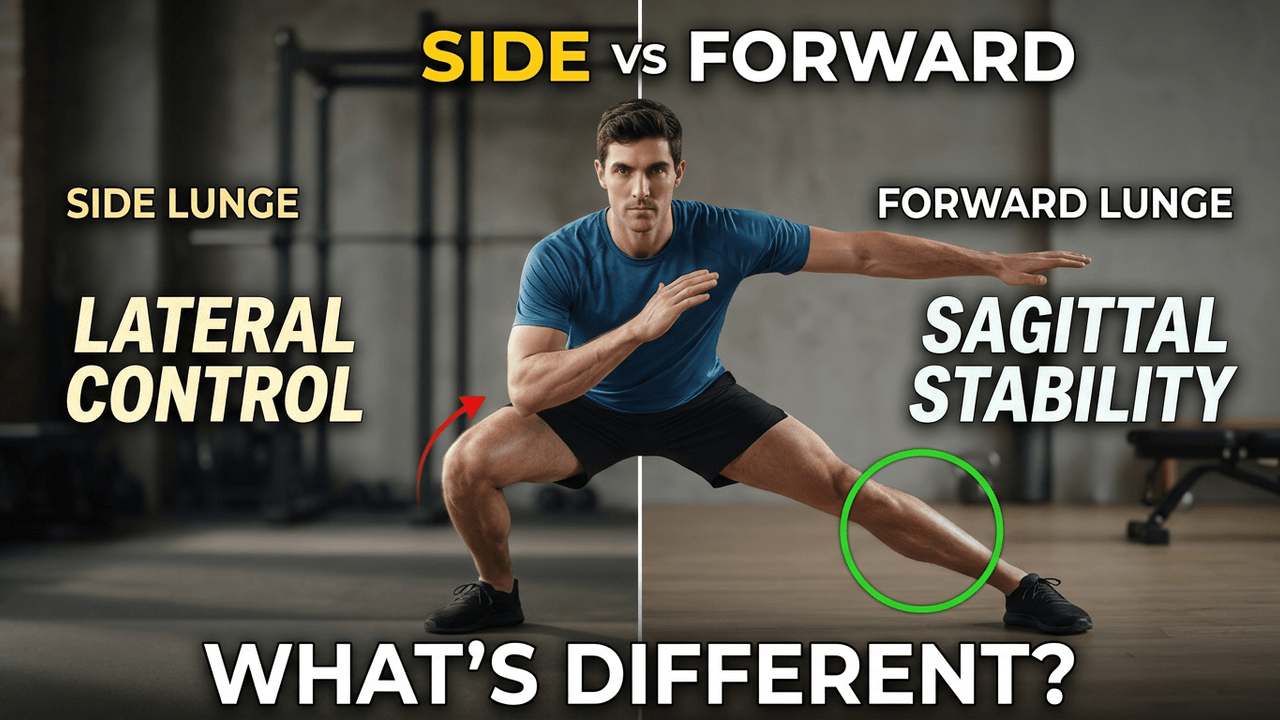
Side lunges — or lateral lunges — look almost like a stretch, don’t they? But compared with a forward lunge, your body has to solve a very different problem. Instead of controlling your weight as it moves forward and back, you have to move it sideways — and then control it as you come back. That changes what your hips, knees, ankles, and even your straight leg have to do. So rather than asking which lunge is better, let’s look at what actually changes when you change direction.
⚠️ Disclaimer: This article is for educational and analytical purposes only. It does not constitute medical or fitness advice. Consult a qualified professional before starting any new exercise programme.
The First Big Difference: Direction
With a forward lunge, your body moves mainly forward and backwards. You step forward, your centre of mass moves toward the front leg, and that leg has to absorb and redirect that movement. With a side lunge, your centre of mass moves sideways toward the stepping leg. That stepping leg becomes your main base of support. It has to catch your sideways movement and then help push you back to where you started.
So a side lunge isn’t simply a forward lunge turned ninety degrees. You’re asking your body to control its mass in a completely different direction. And that changes the job of the working leg.
Watch the video above to see both movements in action.
What Changes at the Hip?
At the hip, both movements use the glutes and other hip muscles to control the descent and help you come back up. But the side lunge adds something the forward lunge doesn’t emphasise in quite the same way: your pelvis is moving sideways over the stepping leg. Your hip therefore has to manage that lateral shift while still controlling the usual bending and straightening of the leg.
And then there’s the opposite leg. As you move toward the stepping side, the straight leg moves farther away from your body. That’s why you often feel a stretch through the inner thigh. As the legs separate, those adductor muscles lengthen while the pelvis continues moving toward the loaded side.
But here’s an important distinction: feeling a stretch doesn’t automatically mean that the muscle is producing a huge amount of force. The straight leg isn’t passive, either. It supports and stabilises you, limits how far your pelvis can travel sideways, and helps keep the movement under control.
And Then There’s the Ankle
Now here’s where the comparison gets particularly interesting: the ankle. You might expect the forward lunge to challenge the ankle more because you’re moving forward. But research comparing forward and lateral lunges has found greater ankle dorsiflexion and greater plantar-flexor demand during the lateral lunge. In contrast, the forward lunge produced greater hip-extensor demand and hip power.
The exact numbers will vary depending on the person and how the exercise is performed, but the overall finding is useful. Changing the direction of the movement changes where the mechanical demand is concentrated. And that may help explain why a side lunge can feel surprisingly different, even when you’re using nothing more than your body weight.
📊 Track your progress: Use our Strength Standards to benchmark your lower-body strength, or the 1‑Rep Max Calculator to estimate your squat and deadlift potential.
Does Going Deeper Make It Better?
Depth changes the exercise too. A shallow side lunge still trains the basic skill of moving your body mass sideways and controlling that shift. As you go deeper, you increase the range of motion at the loaded hip, knee, and ankle, while taking the straight leg farther away from your body. That can certainly increase the challenge, but deeper doesn’t automatically mean better.
If your mobility can’t support that depth, you’re no longer simply adding strength demand. You’re asking your body to control a larger range of motion than it currently owns. So the goal isn’t to get as low as possible. The goal is to control the depth you can actually control.
Are You Actually Shifting Your Weight?
Another detail makes a big difference: how far you step. If you step very wide but don’t move your pelvis toward that foot, much of your weight can remain on the starting leg. You may look like you’re doing a side lunge, but you’re not actually making much of a lateral weight shift.
A good side lunge has a clear sequence: you step out, your body moves across toward that leg, you control the descent, and then you push through that leg to come back. It’s that lateral shift that makes the movement fundamentally different from a forward lunge.
What Happens When You Add Load or a Slider?
Once you have that basic movement under control, you can change the challenge. A goblet hold adds external load, increasing the demand without changing the fundamental side-to-side movement. A sliding side lunge changes things differently — instead of stepping onto a fully planted foot, one leg slides outward while the other leg controls more of the movement. That changes the balance between the moving leg and the supporting leg.
So neither variation changes the fundamental idea. You’re still learning to control your body as it moves sideways. You’re simply asking it to do more.
So, Which Lunge Is Better?
Neither. The forward lunge teaches your body to control movement primarily forward and backwards. The side lunge teaches your body to control movement across your body. That difference changes the demands on the hip, knee, ankle, foot, pelvis, and straight leg.
And that’s exactly why the side lunge deserves a place alongside — not instead of — the forward lunge. Because your body doesn’t only move forward and backwards. It moves sideways too. So why train it in only one direction?
The Bottom Line
Don’t just train the direction you’re most comfortable moving in. Add controlled lateral movement to your training and teach your body to manage its weight from side to side. Train smarter, not harder.
📺 This article was adapted from a PeakPhysic video. Subscribe to PeakPhysic for more science‑backed fitness insights.
Related tools: Strength Standards | 1‑Rep Max Calculator | Waist-to-Hip Ratio | More articles: Analytical Living
Author: Dr. Shirley Cheung. This content is for informational purposes only and does not constitute professional fitness or medical advice.