
What Actually Makes Your Glute Work During a Step-Up?
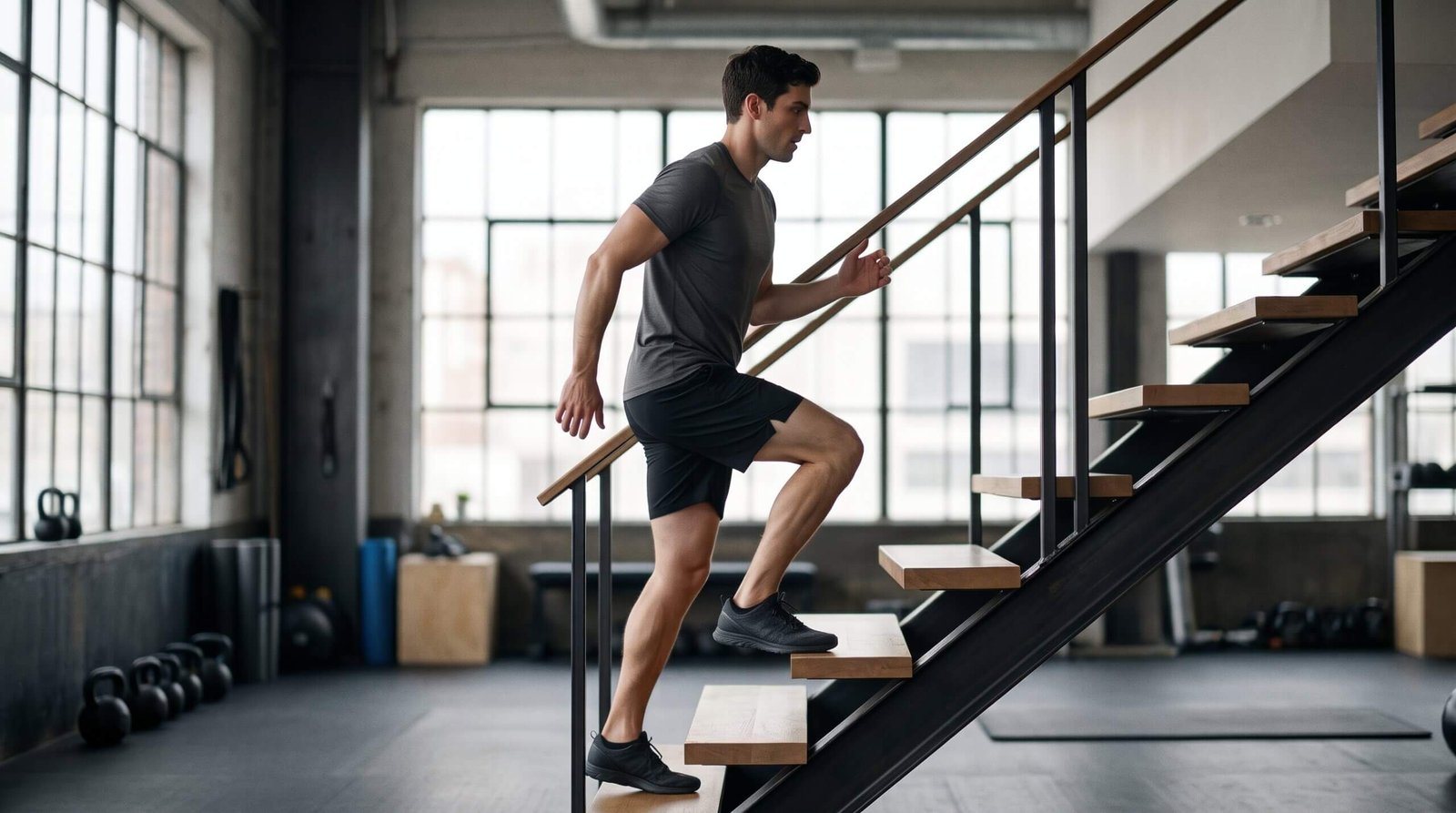
Think about the last time you climbed a few flights of stairs. Your thighs started burning, your glutes started feeling tired, and your legs wanted to stop. That stair climb is really a series of mini step-ups. One leg steps up, your body rises, and your hips and thighs lift you onto the next level. That is why step-ups get recommended as a glute exercise.
But here is what most people don’t know. Your glute does not work just because your foot is on a box. It does not work just because the box is higher. And it does not work because you squeeze hard at the top. Your glute contributes when the leading hip has to extend under load to raise and control your body.
⚠️ Disclaimer: This article is for educational and analytical purposes only. It does not constitute medical or fitness advice. Consult a qualified professional before starting any new exercise programme.
The Glute’s Actual Job
When people say “glute,” they usually mean three muscles: gluteus maximus, gluteus medius, and gluteus minimus.
- Gluteus maximus is the largest and most superficial. It makes up most of the shape of your buttock and powers strong hip extension, running, and climbing stairs.
- Gluteus medius is a medium-sized muscle that sits partly under the maximus on the outer hip. It stabilises your pelvis when you walk and when you stand on one leg.
- Gluteus minimus is the smallest and deepest. It works with the medius to support your balance and internal hip rotation.
Step-ups can target the gluteus maximus because it is a major hip extensor. In a step-up, the leading hip starts in flexion. As you rise, the thigh and pelvis move toward extension. That is the action where the glute can contribute.
Watch the video above to see the setup and movement in action.
Think of the movement as a task your body has to solve. Your body needs to raise its centre of mass. To do that, the leading leg has to produce force against the box. Because the leading hip starts flexed, your hip extensors are in a position to help with the upward movement.
This is the part people miss. The glute is not working because you told it to squeeze. It works because the movement requires hip extension torque. A squeeze can help you feel the muscle, but feeling it is not the same as loading it.
Create the Hip Extension Demand
First, build a useful starting position. Your leading hip should be flexed enough that the leg has to extend as you rise. The step should be high enough to challenge you, but not so high that you have to launch yourself off the floor or lose control.
Place your whole foot on the box. Then adjust until the leading leg can produce the lift without being jammed against the box. If your foot is too close, your knee travels forward first, and the movement becomes knee dominant. Moving the foot slightly farther away creates more hip flexion and lets you hold a controlled forward lean of the torso. That increases the demand around the hip.
The goal is not to reach your foot as far away as possible. The goal is to give the leading hip a real job. You want the leading hip loaded and flexed at the bottom, then extending to raise your body. If the position feels so awkward that you need momentum, or help from the back leg, the setup has stopped helping.
How to Know the Glute Is Contributing
You cannot measure muscle contribution by feel alone. Feeling your glute is not the same as measuring its force, and not feeling it strongly does not prove it is inactive. What you can do is check whether the movement is creating the right conditions. Four things to look for:
- The leading hip starts flexed.
- The leading leg produces most of the upward movement.
- The trailing foot does not push hard.
- The leading hip finishes the ascent and controls the way down.
If those four are there, your leading hip is being asked to contribute. That is a better standard than chasing a burn or squeezing harder.
📊 Track your progress: Use our Strength Standards to benchmark your lower-body strength, or the 1‑Rep Max Calculator to estimate your squat and deadlift potential.
How to Progress the Glute Demand
Once the leading leg is genuinely producing the lift, you have several ways to progress:
- Raise the step height if you want more hip and knee flexion at the start, more vertical travel, and the ability to produce force from a deeper position.
- Add external load if you want more resistance while keeping the pattern similar.
- Reduce the help from your trailing leg if you want a bigger share of the work coming from the leading leg.
- Slow the movement down, or pause before you rise if you want less momentum and more deliberate force.
The order matters. First, create the hip extension demand. Then make the leading leg meet it. Then add resistance. A heavier step-up with a strong push from the floor may do less for your target than a lighter step-up with strict control from the leading leg.
Choosing Your Box Height
Box height changes which muscles take most of the work.
For more glute involvement: use a box where your thigh is roughly parallel to the floor, or slightly higher, when your foot is on top. A deeper hip bend puts the leading hip in a longer position, so the leading leg has to produce more extension as you rise.
For more quad involvement: use a box around knee height or lower, and focus on pushing through the ball of your foot as your knee extends.
One rule applies to both: never go so high that your lower back rounds, or that you have to cheat with momentum from your trailing leg.
The Bottom Line
So what makes a step-up work your glute? The leading hip has to extend under load to raise and control your body. You create that demand with a meaningful hip flexion start, a secure foot placement, a controlled torso position, and by letting the leading leg produce the lift.
Keep the trailing leg from becoming the engine. Do not use a harder squeeze to cover for a setup that does not load the hip. And do not assume that a higher box automatically means more glute work. The box creates the position. The leading leg creates the lift. Your glute contributes because the leading hip has to extend against the load.
Next time you hit the stairs, you will know what your glutes are actually doing. Train smarter, not harder.
📺 This article was adapted from a PeakPhysic video. Subscribe to PeakPhysic for more science‑backed fitness insights.
Related tools: Strength Standards | 1‑Rep Max Calculator | BMI Calculator | More articles: Analytical Living
Author: Dr. Shirley Cheung. This content is for informational purposes only and does not constitute professional fitness or medical advice.