
What Changes When You Hinge on One Leg?
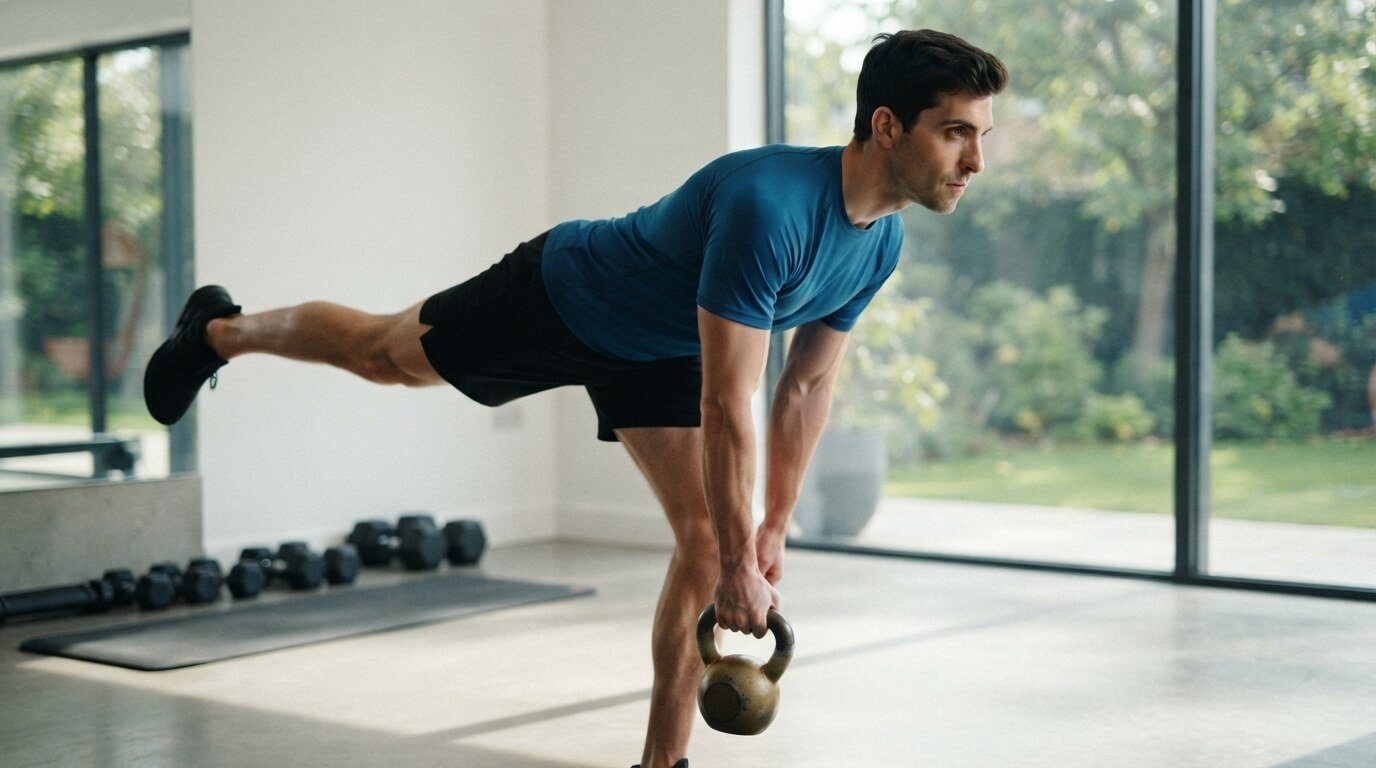
You already know the hip hinge. You push your hips back, lean your chest forward, and feel your hamstrings and glutes working. So what changes when you do that same movement on one leg? Quite a lot. The weight doesn’t have to get heavier. Your body simply has to control more. In this article, we’ll look at what the single-leg deadlift actually trains, why the one-leg version is different, and how to do it properly.
⚠️ Disclaimer: This article is for educational and analytical purposes only. It does not constitute medical or fitness advice. Consult a qualified professional before starting any new exercise programme.
So, What Exactly Is a Single-Leg Deadlift?
The single-leg deadlift is essentially a standing hip hinge performed on one leg. You may also hear it called a single-leg Romanian deadlift, or single-leg RDL. The terminology isn’t completely consistent, but the movement we’re talking about is the same basic idea: hinge from the hip while standing on one leg.
Your standing leg supports you while your hips move backward, your torso moves forward, and your other leg extends behind you for balance. Your glutes and hamstrings drive the hip movement, but now your body also has to keep you balanced while you do it.
Watch the video above to see the movement in action.
What Changes When You Go From Two Legs to One?
Start with the obvious difference: with two feet on the floor, you have a relatively stable base of support. Take one foot away, and that base becomes much smaller. Suddenly, your body has to make constant adjustments to keep your pelvis, trunk, and standing leg under control.
Your standing hip has to help keep your pelvis level instead of letting it simply rotate or drop. Your trunk has to resist unwanted rotation while your hips are moving. And your foot and ankle have to make small adjustments to keep you balanced over that one point of contact with the floor.
So the single-leg deadlift isn’t simply a harder version of the same exercise. It asks your whole system to coordinate the hinge while maintaining balance and control.
What Muscles Does It Actually Train?
The main movement is still a hip hinge, so the glutes and hamstrings remain the primary muscles producing the movement. But the one-leg position adds another layer of stabilisation.
- Gluteus medius and other hip muscles help control the pelvis.
- Abdominal and oblique muscles help resist unwanted movement through your trunk.
- Foot and ankle muscles contribute because they have to keep you stable on a much smaller base.
So I wouldn’t call the single-leg deadlift a full-body exercise. It’s still fundamentally a posterior-chain hip hinge, but the stabilising demands extend well beyond the glutes and hamstrings.
What Does the Single-Leg Version Give You?
The biggest difference is that you’re producing hip movement while standing on one leg. That means you’re training single-leg strength while also controlling your balance. You’re also asking the hip to control the position of your pelvis, while your trunk resists rotation. And you’re learning to control your centre of mass while your body is moving through space.
That’s useful because a lot of normal human movement happens one leg at a time. Walking, running, stepping, and changing direction all involve periods where one leg has to support and control the body. The exercise doesn’t magically improve all of those activities, but it trains some of the same basic abilities: single-leg control, balance, and hip stability.
📊 Track your progress: Use our Strength Standards to benchmark your lower-body strength, or the 1‑Rep Max Calculator to estimate your deadlift potential.
What Should You Actually Feel?
During a good repetition, you should mainly feel the glute and hamstring of your standing leg working as your hip moves backward and then drives you back to standing. You may also notice the muscles around the outside of your standing hip working to keep your pelvis controlled. Your foot and ankle may feel active as they make small adjustments to keep you balanced. And your abdominal and oblique muscles may work to keep your trunk from rotating.
What you shouldn’t be relying on is excessive lower-back loading, twisting through your torso, or repeatedly losing your balance.
How to Do a Single-Leg Deadlift Properly
- Start by standing tall with your feet about hip-width apart.
- Shift your weight onto one foot and keep that foot firmly connected to the floor.
- Think about creating a tripod with your foot: heel, base of the big toe, and base of the little toe stay connected.
- Keep a soft bend in your standing knee.
- Push your hips backward, as if you’re trying to close a car door with your butt.
- Let your other leg extend behind you as a counterbalance.
- Keep your pelvis level and avoid letting your body rotate open.
- Keep your spine long and your neck neutral as you hinge forward.
- Lower only as far as you can maintain control, balance, and a clean hip hinge.
- Drive through the whole foot and squeeze the glute to return to standing.
If balance is the thing limiting you, lightly hold onto a stable support while you learn the movement.
The Biggest Mistakes
- Allowing the pelvis to open as the rear leg rises.
- Twisting the torso instead of moving from the hip.
- Standing knee collapsing inward as you try to balance.
- Turning it into a squat by bending the standing knee too much and dropping the hips straight down.
- Sacrificing control for depth. A smaller range of motion with good control is more useful than reaching lower while losing the movement you’re trying to train.
The Bottom Line
The single-leg deadlift is still a hip hinge. But taking one foot away changes the challenge completely. Now you’re not only moving through the hips — you’re balancing, controlling your pelvis, resisting rotation, and stabilising through your foot and ankle at the same time. That’s what makes the single-leg version useful. It combines a familiar hip-hinge pattern with the control demands of standing on one leg.
If you’ve already learned the hip hinge, this is a natural way to make that movement more demanding without simply adding more weight. Know what you’re training, control the movement, and progress it when you’re ready. Train smarter, not harder.
📺 This article was adapted from a PeakPhysic video. Subscribe to PeakPhysic for more science‑backed fitness insights.
Related tools: Strength Standards | 1‑Rep Max Calculator | BMI Calculator | More articles: Analytical Living
Author: Dr. Shirley Cheung. This content is for informational purposes only and does not constitute professional fitness or medical advice.