
Did I Really Work Out If I’m Not Sore?
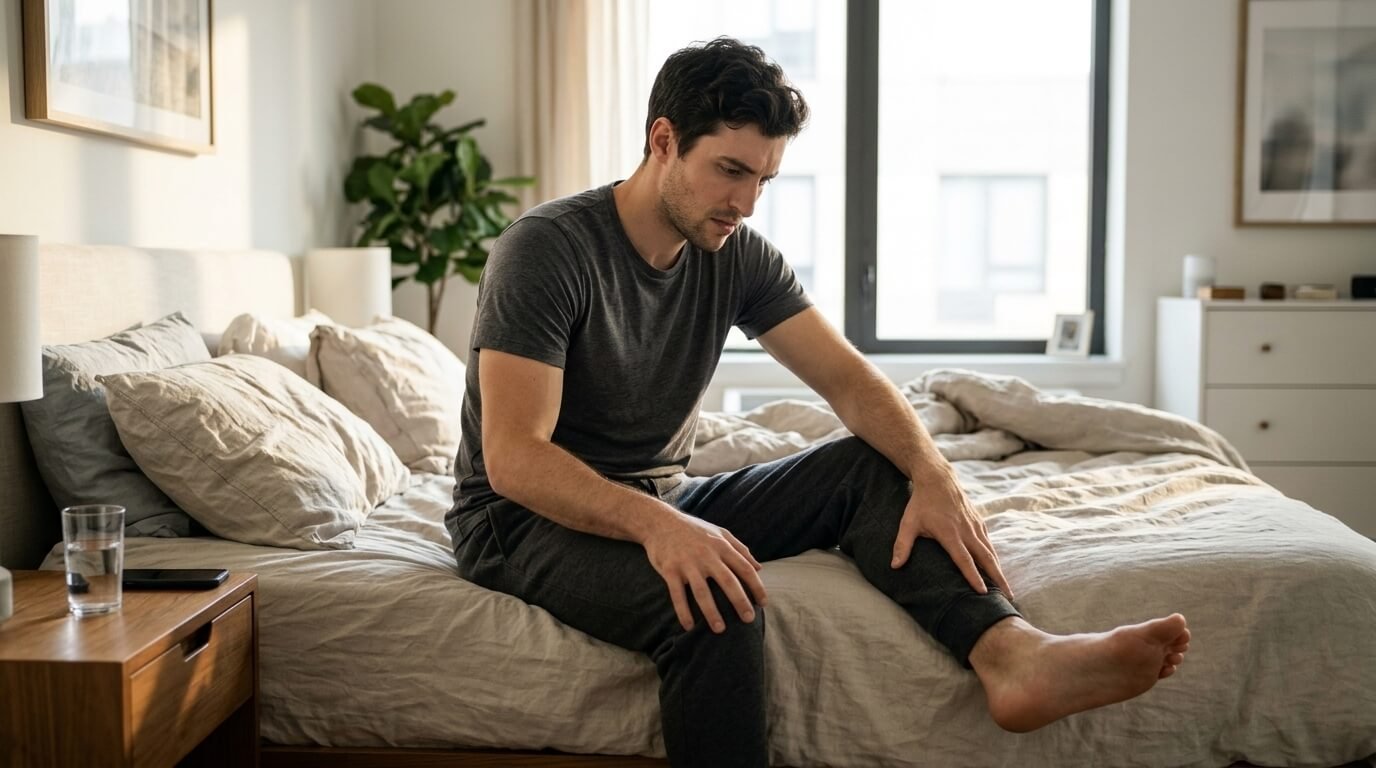
You worked out yesterday. You did your squats, trained your legs, maybe even struggled through those last few repetitions. So this morning, you expect to feel it. But when you get out of bed, walk around, and climb the stairs… nothing. Your legs feel completely normal.
And now you’re wondering: Did I actually work out hard enough? Why am I sore after some workouts, but not this time? Am I doing something wrong?
If you’re a beginner, these questions can be really confusing. You hear people talking about sore muscles after the gym, and it’s easy to assume that if you aren’t sore, your workout must have been too easy. They walk around with soreness like a trophy, wearing pain as a badge of honor. But here’s the problem with using soreness as your scorecard: your muscles can adapt and get stronger without making you sore after every workout.
⚠️ Disclaimer: This article is for educational and analytical purposes only. It does not constitute medical or fitness advice. Consult a qualified professional before starting any new exercise programme.
Why Do Muscles Get Sore?
That stiffness and tenderness you sometimes feel hours after exercise is called delayed-onset muscle soreness, or DOMS. Unlike discomfort you might feel during a difficult repetition, DOMS usually develops later. It often begins around 12 to 24 hours after exercise and can peak over the following one to three days.
You’re more likely to experience it when you try an unfamiliar exercise, suddenly do more repetitions than usual, increase your workload significantly, or return to training after a break. Exercises that emphasize the lowering phase can also produce considerable soreness — think about lowering yourself into a squat, lowering a dumbbell during a curl, or walking downhill.
During exercise, your muscles and surrounding tissues experience mechanical stress. With unfamiliar or demanding exercise, this can trigger a complex response involving inflammation and increased sensitivity of pain-sensing nerve endings. That’s part of why the affected muscles may feel tender, stiff, or uncomfortable afterwards.
And no, it isn’t simply lactic acid sitting in your muscles. Nor does soreness automatically mean you’ve torn muscle fibres and must now grow bigger. The exact mechanisms behind DOMS are still being investigated, but one thing is clear: soreness is a response to exercise-related stress. It is not a direct measurement of muscle growth.
Watch the video above for the full breakdown.
Why Does Soreness Disappear When You Keep Training?
Let’s say you haven’t exercised for months. You do a few sets of squats, and the next day your legs are sore. You recover, then repeat a similar workout a few days later. You might still feel some soreness. But after several sessions, you notice something interesting: the same squats no longer leave your legs aching as much.
Did the exercise stop working? Not necessarily. Your body has become better adapted to that particular challenge. This protective adaptation is known as the repeated bout effect.
With repeated exposure to similar exercise, people generally experience less soreness and less exercise-related muscle damage than they did after the initial bout. Your movement may become more coordinated, and your muscles and surrounding tissues become better accustomed to the demands being placed on them.
The important point is that the same familiar workout can produce less soreness even while your training continues to be productive. Think about it. If you had to feel as sore as you did on your very first workout to keep making progress, every successful training programme would eventually become a problem. Fortunately, that isn’t how adaptation works.
If I’m Not Sore, How Do I Know My Workout Worked?
Instead of asking, “Am I sore today?”, ask yourself: “Am I getting better at the things I’m training?”
For example, imagine that you’re doing goblet squats with a dumbbell. In your first session, you manage eight controlled repetitions with a particular weight. Over the following weeks, you can perform ten, then twelve repetitions with that same weight and similar technique. Or perhaps you can eventually use a heavier dumbbell while maintaining good control. That’s measurable progress.
One way to continue challenging yourself is through progressive overload — gradually increasing the weight, the repetitions, or the difficulty of the movement over time. It’s the principle that drives long-term progress, and it doesn’t require you to be sore to work.
There are other useful signs, too. Can you control the movement better? Can you use a comfortable, appropriate range of motion? Can you perform your planned sets with good technique and gradually increase the challenge over time?
📊 Track your real progress: Use our Strength Standards to benchmark your lifts, or the 1‑Rep Max Calculator to see measurable strength gains over time.
For muscle growth, your sets also need to provide an appropriate training stimulus. If every set is so easy that you could effortlessly repeat it many more times, you may need to adjust the challenge. But that doesn’t mean every set must end in complete exhaustion.
And remember, one session tells you very little about your long-term results. Progress is easier to judge across several weeks of consistent training.
Research supports this distinction between soreness and adaptation. In one eight-week human study involving eccentric cycling, participants who had adapted to the exercise experienced much less soreness and muscle-damage response, yet achieved similar strength and muscle-size gains to the comparison group. That was a specific study, not proof that every training programme works the same way. But it illustrates the central point: less soreness does not automatically mean less progress.
Should I Ever Pay Attention to Soreness?
Yes, but use it as information, not as your goal. Mild muscle soreness after an unfamiliar workout is common. It may tell you that you introduced a new or greater challenge than your body was accustomed to. If you’re very sore, you may also need to adjust your next session so you can move comfortably and maintain good technique.
But soreness is not something you need to manufacture. Deliberately making yourself excessively sore can interfere with your ability to train consistently.
And don’t confuse delayed muscle soreness with sharp pain during a repetition. Sudden, stabbing, localized, or joint pain is a different issue. Stop the movement rather than trying to push through it. Severe muscle pain accompanied by marked swelling, unusual weakness, or dark urine warrants urgent medical attention.
The goal isn’t to avoid every sensation, nor is it to chase pain. It’s to train in a way you can recover from and repeat.
The Bottom Line
Let’s return to that original question. You worked out yesterday. Today, you’re not sore. Did you waste your workout?
No. Not being sore does not mean your workout was ineffective.
Soreness often reflects how your body responds to an unfamiliar exercise or workload. As you repeat that exercise, soreness can decrease because your body has adapted. To judge whether your training is working, look at the quality of your exercise, whether your sets are appropriately challenging, how well you recover, and whether your performance improves over time via progressive overload.
Give your training a few weeks. Track your repetitions and resistance. Look for better control and gradual progress. Don’t demand that your muscles hurt tomorrow as proof that you did something today.
Because the goal isn’t to become sore. The goal is to become stronger. Train smarter, not harder.
📺 This article was adapted from a PeakPhysic video. Subscribe to PeakPhysic for more science‑backed fitness insights.
Related tools: Strength Standards | 1‑Rep Max Calculator | BMI Calculator | More articles: Analytical Living
Author: Dr. Shirley Cheung. This content is for informational purposes only and does not constitute professional fitness or medical advice.