
What Do Step-Ups Actually Train?
Adapted from a video on my PeakPhysic YouTube channel. Subscribe for more science‑backed fitness insights.
Watch the video above, then read on for the full breakdown of the muscles and movement patterns involved.
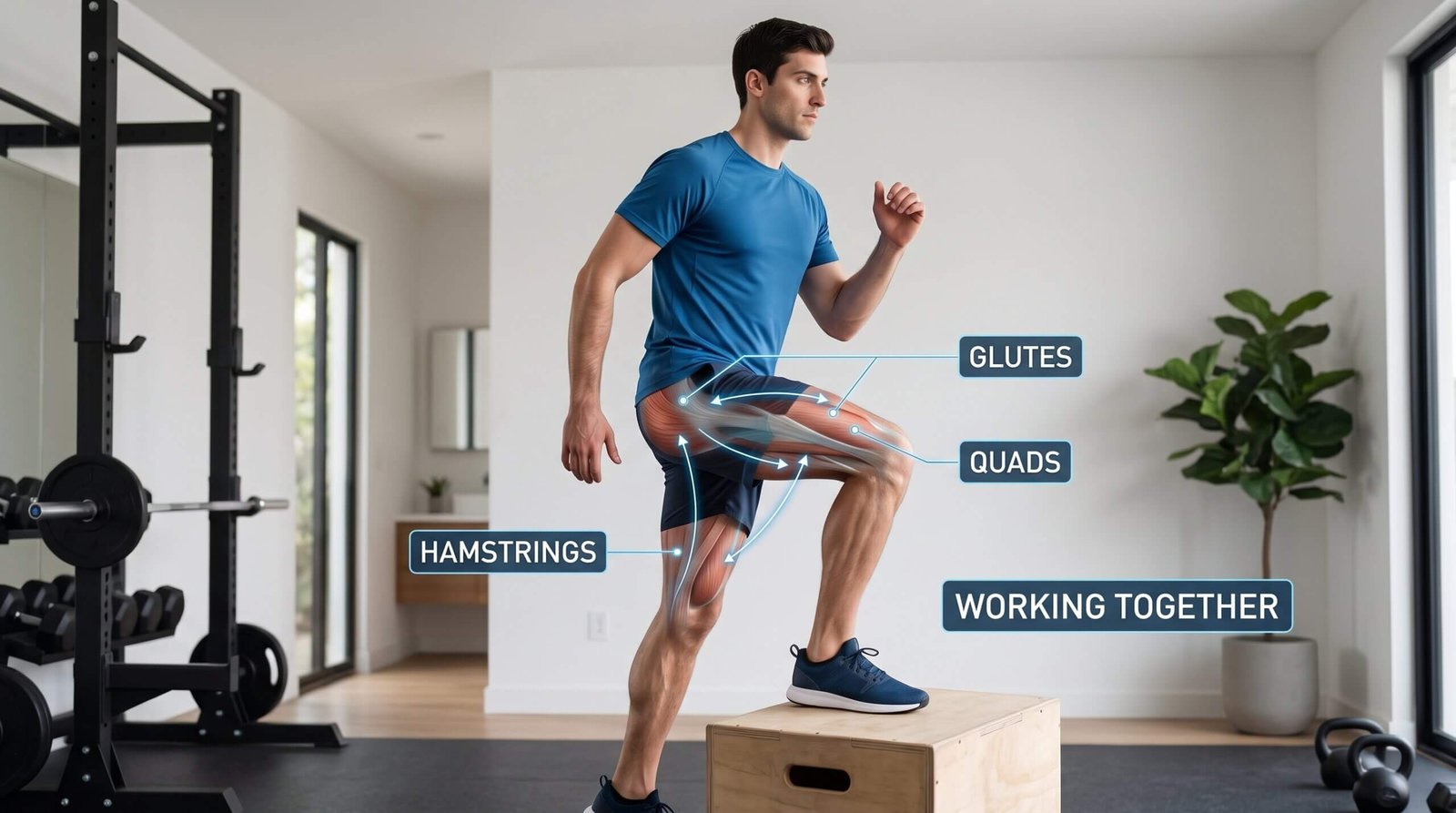
Most people think step-ups are just a quad exercise. Muscle activation studies say otherwise. What are you actually training when you step up onto a platform? It’s a leg exercise — but a step-up asks your body to do much more than just lift one foot onto a step. It trains your glutes, quads, and hamstrings, while also challenging your balance, stability, and coordination.
⚠️ Disclaimer: This article is for educational and analytical purposes only. It does not constitute medical or fitness advice. Consult a qualified professional before starting any new exercise programme.
How to Perform the Step-Up Properly
- Use a low, stable platform. If you don’t have one, the first or second step of a staircase works — just make sure it’s stable and fits your whole foot.
- Stand facing the step.
- Place your entire right foot firmly on the step.
- Lean slightly forward from the hips and push through the planted foot to bring your body up.
- Bring the other foot onto the step.
- Step back down under control.
- Repeat on the same side or alternate legs.
Think like this: Whole foot on. Drive up. Control the way down. Keep your knee tracking roughly in line with your second toe and your torso controlled throughout.
One common mistake: letting your knee cave inward as you stand up. If you feel your knee collapsing inward, lower the step height and focus on control.
What You’re Actually Training
Glutes
When you push your body upward from the step, your hip has to extend. Your glutes are one of the main muscles producing that movement. This is one reason step-ups can be a very effective glute exercise. In fact, electromyography (EMG) studies have found that step-up variations can produce some of the highest gluteus maximus activation levels of any common lower-body exercise, often exceeding 100% of maximum voluntary contraction. That’s in the same range as hip thrusts and deadlifts. The higher the step, the more hip flexion you start with, which can change the demands on the hip and lower body. Your glutes are helping drive your body upward — hard.
Quads
Your quadriceps — the muscles at the front of your thigh — are working too. They help control your body as you load the front leg, then help extend the knee as you rise. There are two parts to the movement: control the movement, and drive the movement upward. That’s where the step-up becomes useful for developing unilateral lower-body strength.
Hamstrings
Your hamstrings are also involved. They contribute to hip extension and help with control around the hip and knee as you move onto and off the step. Just like the reverse lunge, this is a coordinated lower-body effort. Glutes. Quads. Hamstrings. Working together.
📊 Track your strength progress: Use our 1‑Rep Max Calculator to estimate your lower‑body strength, and Strength Standards to benchmark your lifts by age and gender.
Balance and Stability
A step-up requires you to shift your body weight onto one leg and control yourself as you rise. Your ankle, knee, hip, and core all have to work together to keep you stable. You’re not simply producing force — you’re controlling your body while your weight moves upward. That is an important part of what makes step-ups different from a basic two-leg exercise.
Step Height Matters
Most people think: higher step = harder exercise. That’s true to an extent. But step height can also change which joints and muscles do most of the work, rather than just making everything harder.
Research has found that higher steps increase knee and hip flexion, which increases the work required from the hip extensors (glutes and hamstrings) and knee extensors (quads). Forward step-ups place greater demand on the hip extensors, while lateral step-ups place greater demand on the knee extensors and ankle plantar flexors.
So your step height and step direction are not just ways to make the exercise harder. They can change how your body performs the movement. For most people learning the exercise, starting with a low, stable step gives you a chance to practise the movement and control first.
Why This Matters Outside the Gym
Think about climbing stairs. Stepping onto a curb. Stepping up onto a raised surface. These are everyday movements that require your lower body to produce force while keeping you balanced and coordinated. In a training study, just six weeks of weighted step-up training improved lower-limb power by about 10% and stair-climbing time by around 9%, with only two sessions per week. You’re practising something your body actually uses. That’s a pretty useful exercise.
One Leg at a Time
Each repetition asks one leg to take the lead. That allows you to notice how each side handles the movement. One side may feel stronger. One side may feel more stable. One side may simply feel more coordinated. Train both sides consistently and pay attention to how each side feels. If one side consistently feels weaker or less stable, then you know which side should get more training to get it stronger.
The Bottom Line
Step-ups are simple to perform, need very little space, and train lower-body strength, balance, and coordination. You can use a stable exercise platform or, at home, the first or second step of a staircase. Try this: do 3 sets of 8 controlled step-ups per leg, 2–3 times per week, on a step that feels challenging but controllable. Over 4 weeks, notice any changes in how stairs, curbs, or getting up from a chair feel. That’s the kind of transfer that makes step-ups worth keeping in your routine.
📺 This article was adapted from a PeakPhysic video. Subscribe to PeakPhysic for more science‑backed fitness insights.
Related tools: 1‑Rep Max Calculator | Strength Standards | BMI Calculator | More articles: Analytical Living
Author: Dr. Shirley Cheung. This content is for informational purposes only and does not constitute professional fitness or medical advice.