
Goblet Squat: What Holding the Weight in Front Changes
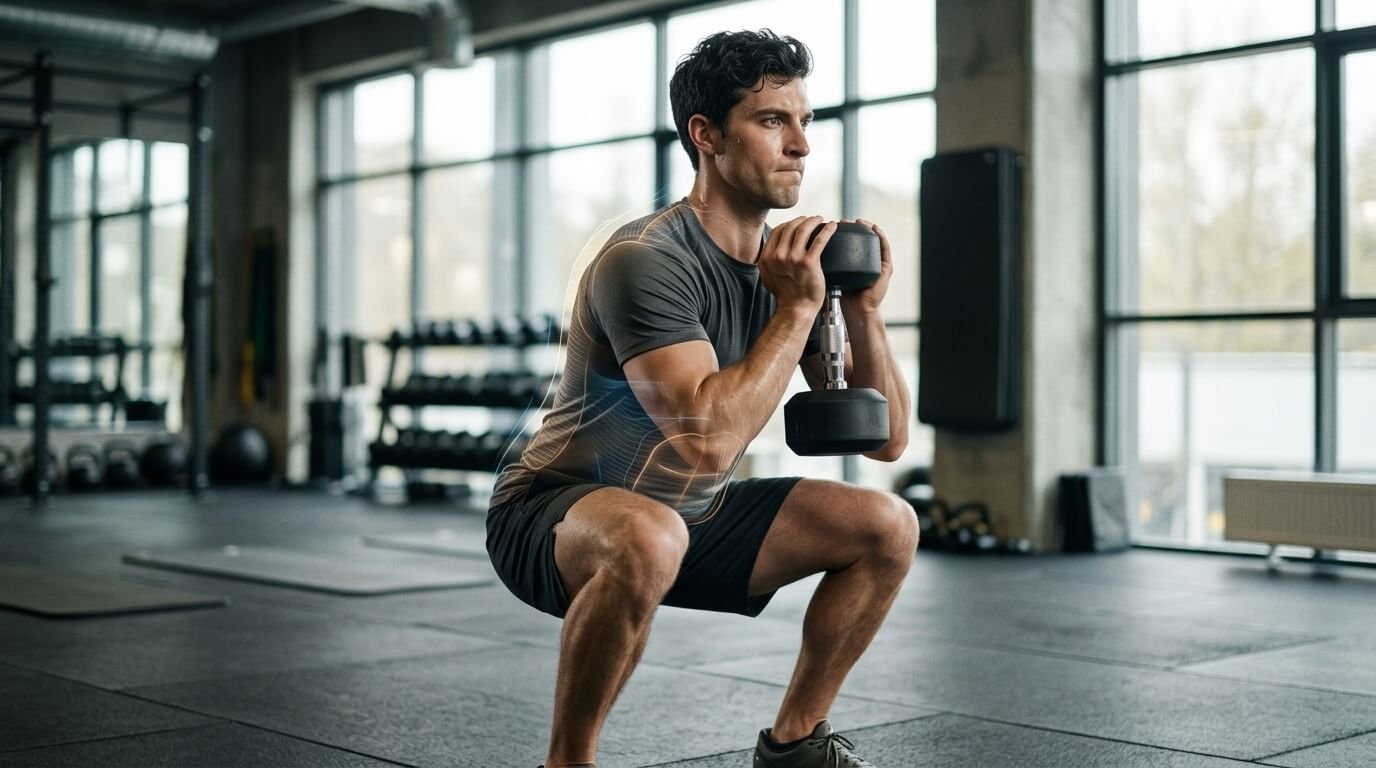
Whether goblet squats are new to you or you have already tried a few, you may have some questions. If you have not done one before, your first question might be, “What exactly is a goblet squat?” And if you have tried it, you may be wondering why a relatively light dumbbell or kettlebell can feel so demanding — or why holding it in front makes moves feel more upright and controlled.
Why can you sometimes reach a deeper, more controlled position? Does the front position make the squat more quad-focused? And if your torso is more upright, does that automatically mean less demand on your back? Then, as the weight gets heavier, why might your arms, grip, or upper back fatigue before your legs?
These questions are connected by one mechanical change: you moved the load from behind your torso to in front of it. That shifts the combined centre of mass forward. It can help keep your body balanced over your feet and encourage a more upright torso. But the same front position also creates a longer lever against your trunk and upper body. So the goblet squat can feel more stable in one sense while becoming more demanding in another. That is why a goblet squat is not simply a lighter version of a back squat. It is the same broad squat pattern, but the body is solving a different balance and support problem.
⚠️ Disclaimer: This article is for educational and analytical purposes only. It does not constitute medical or fitness advice. Consult a qualified professional before starting any new exercise programme.
Why the Weight Position Matters
When you squat, your body and the weight you’re holding form one combined system. To remain balanced, that system’s centre of mass needs to stay over your base of support, roughly the area between your feet. A back squat places the bar across your upper back or shoulders. A goblet squat places the dumbbell or kettlebell in front of your chest. That changes the balance problem.
The front-held weight can help some people keep their torso more upright and control the descent without feeling as though they’re falling backwards. This is why even a relatively light weight can sometimes make a squat feel easier to balance. But there is a catch. The weight is also an external load that you must support. And because it sits in front of your spine, it creates a rotational force that your trunk muscles have to resist. So the front load can help with balance while increasing the work needed to control the trunk.
Watch the video above to see the movement in action.
What Changes at the Hips and Knees?
The position of the weight can also influence how your hips and knees contribute to the squat. Compare a more forward-leaning squat with one in which the torso stays relatively upright. A forward-leaning torso generally increases the external moment around the hip, requiring the hip extensors to produce more torque. A more upright torso tends to reduce that hip moment and can increase the relative demand on the knee extensors, particularly when the knees travel farther forward.
This helps explain why a goblet squat can feel more knee-focused than some back-squat variations. But don’t turn that tendency into a rigid rule. The actual demand depends on more than the exercise name. Your depth, stance, ankle position, knee travel, and torso angle all influence the mechanics. The load position influences the movement, but it doesn’t dictate every part of it.
Why Upright Doesn’t Automatically Mean Less Back Demand
You might assume that keeping your torso more upright automatically reduces the work your back has to do. Not necessarily. When you lean forward, the weight of your torso creates a moment around your lower back. Holding a weight in front introduces another load positioned anterior to your spine. Your trunk muscles must generate the necessary counter-moment to control that load.
A 2020 study that manipulated load position during squatting found that more anterior loading reduced trunk flexion but increased the net extension moment at the lower back. In other words, the participants stood more upright, yet the load position still increased the demand on the system controlling the trunk.
There is an important caveat: this was a variable-load-position study, not a direct test of every goblet-squat technique. Still, it demonstrates a useful principle: how upright you look doesn’t tell you the whole story about how much work your back is doing. You also need to consider where the load is positioned.
The Same Weight, a Different Lever
Imagine holding a ten-kilogram dumbbell close to your chest. Now imagine holding that same dumbbell farther in front of you. The weight hasn’t changed, but the distance has. Mechanically, a force acting farther from a joint creates a larger moment arm, increasing the rotational demand that must be controlled.
Holding the dumbbell farther forward can therefore increase the demands on your trunk, shoulders, and arms. This is why keeping the weight close to your chest makes the conventional goblet-squat position easier to control. Moving it farther forward isn’t automatically a better way to train your legs — you may simply make your upper body work harder to support the same load. The useful lesson is that resistance isn’t determined by weight alone. Its position matters too.
📊 Track your progress: Use our 1‑Rep Max Calculator to estimate your squat strength, and Strength Standards to benchmark your lifts by age and gender.
Is It More for Quads or Glutes?
The quadriceps extend the knees as you rise. The gluteus maximus contributes to hip extension, particularly when the hips are substantially flexed at the bottom. Both have important roles. A relatively upright torso can increase the relative demand on the knee extensors, while greater hip flexion and changes in torso position can influence the demand on the hip extensors.
But I wouldn’t label every goblet squat as automatically quad-dominant or glute-dominant. Direct research comparing goblet squats with other squat variations remains limited. One study found higher quadriceps EMG during goblet squats than during landmine squats under its particular testing conditions. That doesn’t prove goblet squats build more quadriceps muscle than back squats. And remember, EMG measures electrical activity — it doesn’t directly tell us how much muscle growth an exercise will produce.
The better approach is to understand how the movement is loaded, rather than trying to assign each squat variation a single muscle label.
When the Upper Body Becomes the Limiter
A goblet squat is a legitimate strength exercise, not merely a beginner’s introduction to squatting. But the way you hold the weight creates a practical limitation. As the dumbbell or kettlebell gets heavier, your legs may still be capable of producing more force, yet your grip, arms, shoulders, or upper back may become the limiting factor.
You might struggle to keep the weight close to your chest before your legs have reached their own loading limit. At that point, the goblet squat still trains the lower body, but it may no longer be the most practical way to increase the load. A barbell front squat, back squat, safety-bar squat, or belt squat can allow greater lower-body loading without requiring your arms to hold the entire implement in front of you. That’s not about declaring one exercise superior. It’s about recognising what limits each exercise.
Putting It Into Practice
When performing a goblet squat for strength, keep the weight close to your chest so you can control it without turning the set into an arm-endurance exercise. Use a stance and foot angle that allow your knees to track naturally. Keep your trunk stable, but don’t force it to remain perfectly vertical — some forward inclination is normal.
Choose a depth you can control. The front load may help you balance at a deeper position, but it doesn’t eliminate the need for sufficient joint movement and control. Then progress the exercise by adding load or repetitions, or by improving control where that serves your training goal.
Pay attention to what actually limits the set. If your legs are doing the limiting, the goblet squat may still be an effective loading option. If your grip or upper body gives out first, a different squat variation may be the more productive next step.
The Bottom Line
Moving the weight to the front changes more than how you hold a dumbbell. It changes the balance problem, influences your torso position, affects the relative demands on your hips and knees, and creates a new challenge for your trunk and upper body.
The most useful question isn’t simply whether goblet squats are better for quads or glutes. It’s this: Where is the load, how far is it from your body, and what is actually limiting your movement?
During your next goblet squat, keep the weight close to your chest and notice what limits your set first: your legs, or your ability to support the weight. If your upper body gives out before your legs, consider whether another squat variation would let you continue progressing your lower-body strength more effectively. Train smarter, not harder.
📺 This article was adapted from a PeakPhysic video. Subscribe to PeakPhysic for more science‑backed fitness insights.
Related tools: 1‑Rep Max Calculator | Strength Standards | BMI Calculator | More articles: Analytical Living
Author: Dr. Shirley Cheung. This content is for informational purposes only and does not constitute professional fitness or medical advice.