
The Plank Variation That Hits What Your Plank Never Does
The Plank Variation That Hits What Your Plank Never Does
Adapted from a video on my PeakPhysic YouTube channel. Subscribe for more science‑backed fitness insights.
Watch the video above, then read on for the full breakdown of form, progressions, and the science behind the side plank.
You’re probably already well-versed in the classic forearm plank — that stalwart core exercise that’s great for building general abdominal endurance. But if you’ve been doing the same plank day after day, you should explore this simple way to unlock a whole new set of benefits. This is one of the smart variations: the side plank, which helps target muscles your usual plank barely touches.
⚠️ Disclaimer: This article is for educational and analytical purposes only. It does not constitute medical or fitness advice. Consult a qualified professional before starting any new exercise programme.
How to Do the Side Plank (With Progressions)
Start simple and build up as you get stronger.
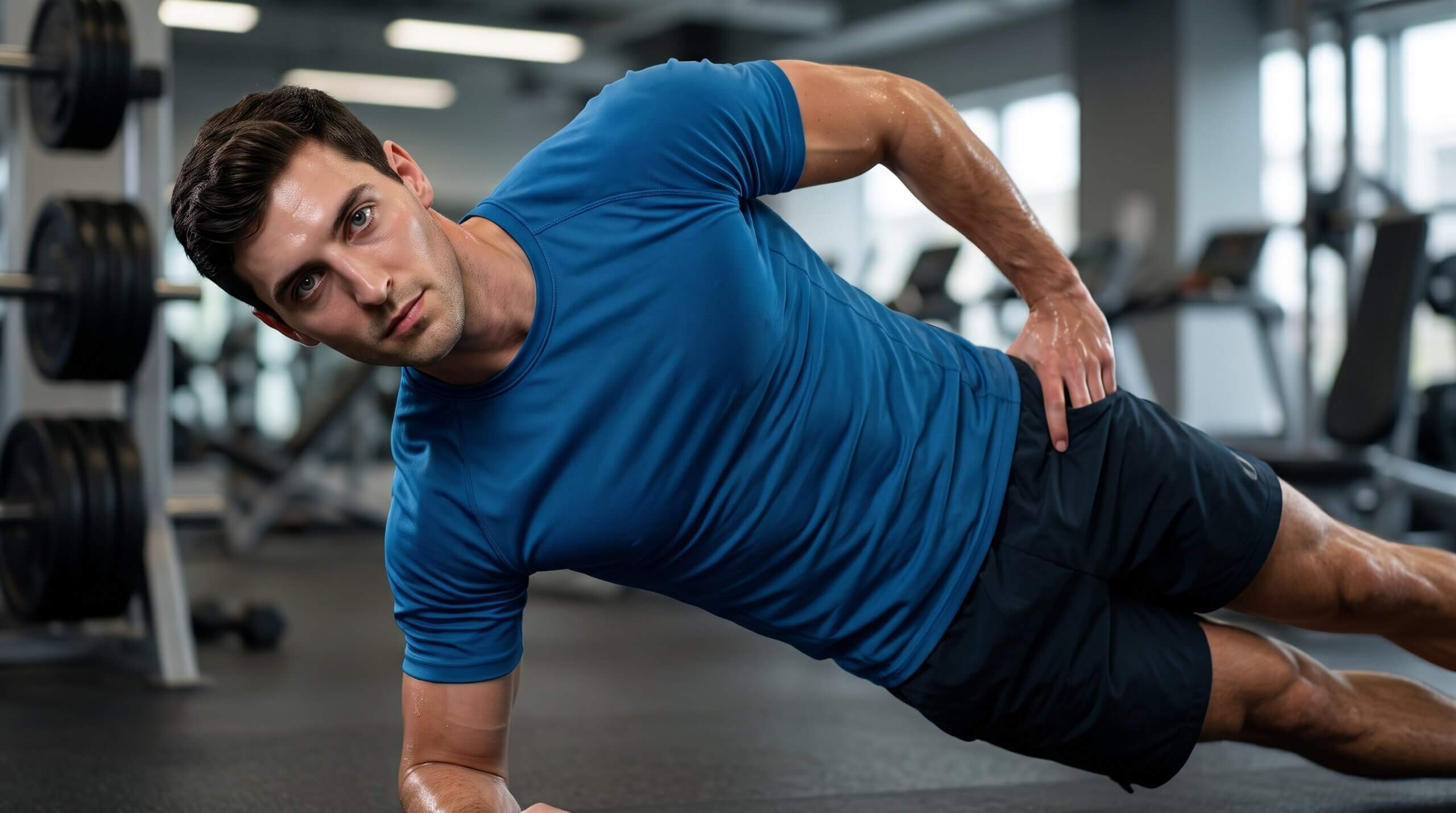
Basic side plank: Lie on your side, stack your feet, and prop yourself up on your forearm, elbow under your shoulder. Lift your hips so your body forms a straight line from head to heels. Hold for 20 to 30 seconds, then switch sides.
Easier version: If that’s too much to start, bend your knees and lift from your knees instead of your feet. That reduces the load while still engaging your obliques directly.
Harder version: Once the basic hold feels solid, lift your top arm straight up toward the ceiling, or add a hip dip — lowering and lifting your hips a few inches without losing the line.
Whichever version you’re on, the same cue applies: keep your hips high and your core tight. Don’t let your bottom hip sag. That’s what actually makes your obliques do the work.
Form Cues to Lock In
- Stack your shoulder directly above your elbow — or your wrist, if you’re pressed up on your hand. That keeps a strong line of support and protects your shoulder joint.
- Check your alignment before you lift: elbow right under your shoulder, forearm pointing straight ahead, so wrist, elbow, and shoulder form one clean vertical line.
- Keep your head in line with your spine — no dropping, no craning. Ears stacked over your shoulders, eyes forward or slightly up.
- Breathe steadily the whole way through — inhale through your nose, exhale through your mouth, core engaged the entire hold. Holding your breath just adds tension and cuts your hold time short.
Why the Side Plank Earns Its Place
The side plank is a powerhouse for your obliques — the muscles running along the sides of your torso. There are two layers: the external obliques, closer to the surface, and the internal obliques, underneath. Together they’re crucial for rotating your trunk, stabilising your spine, and even helping prevent low‑back and hip pain.
Studies measuring muscle activity directly — with electrodes on the muscle itself — consistently show side planks producing meaningfully higher oblique activation than a standard prone plank [1] [2].
And this isn’t just about how your midsection looks. Your obliques do real work every day — turning to look behind you while driving, carrying groceries in from the car, keeping your balance while playing with your kids. Add side planks into your routine, and you’re not just doing more planks — you’re building a more resilient, functional core that supports your metabolism and your posture right along with it.
How Long to Hold
If you’re just starting out, aim for 10 to 30 seconds per side, two to three sets, two to three times a week. Once you can hold 30 to 60 seconds with good form, you’re building real core endurance — add a hip dip or leg lift here instead of just chasing longer time.
And if you can hold a side plank for 90 seconds with perfect form, that puts you in the top 10% of the population for core endurance. Past that point, adding movement is more effective than adding more seconds.
Form always beats duration. Fifteen seconds done perfectly is worth more than sixty seconds with your hips sagging.
More in Your Core Toolkit
Once you’ve got the side plank down, there’s a whole toolkit of other plank variations depending on what you’re actually trying to work on — a straight‑arm high plank that shifts more load onto your shoulders and chest, plank jacks that turn it into cardio, a reverse plank that flips the focus onto your hamstrings and glutes, and a handful of others in between. Fifteen variations in total, each one hitting something a little different.
🩺 See your full fitness picture: Start with our Your Fitness Vitals hub — BMI, body fat %, waist‑to‑hip, heart rate zones, VO₂ max, strength standards, and calorie target all in one guided flow.
The Bottom Line
You don’t need to throw out your regular plank — front and side train different things, and a well‑rounded core wants both. But if all you’ve ever done is the front version, your obliques have been sitting this one out. Give them their turn. That’s training smarter, not harder.
📺 This article was adapted from a PeakPhysic video. Subscribe to PeakPhysic for more science‑backed fitness insights.
📚 Sources
- Moreno‑Navarro P, Sabido R, Barbado D, Prat‑Luri A, Vera‑Garcia FJ. Trunk muscle activation in prone plank exercises with different body tilts. Journal of Back and Musculoskeletal Rehabilitation, 2024.
- Can EN, Harput G, Turgut E. Shoulder and Scapular Muscle Activity During Low and High Plank Variations With Different Body‑Weight‑Bearing Statuses. Journal of Strength and Conditioning Research, 2024.
Related tools: BMI Calculator | Body Fat % Estimator | Waist‑to‑Hip Ratio | Your Fitness Vitals | More articles: Analytical Living
Author: Dr. Shirley Cheung. This content is for informational purposes only and does not constitute professional fitness or medical advice.