

The Only Guide You’ll Ever Need

Source: theshirlshirl.com
What even is ROAS?
Let’s skip the jargon. ROAS is just a fancy way of asking one question:
“For every $1 I spend on ads… how much money comes back?”
If you spend $100 on ads and make $400 in revenue, your ROAS is:
ROAS = 400 ÷ 100 = 4× (or 400%)The ROAS formula
ROAS = Revenue from Ads ÷ Cost of Ads
Source: theshirlshirl.com
Why ROAS matters (even if you hate math)
ROAS tells you:
- Which ads are printing money
- Which ads are burning money
- Which campaigns should be paused
- Which campaigns deserve more budget
- Whether your ad strategy is actually sustainable
The ROAS cheat table
| ROAS | Meaning | Should you panic? |
|---|---|---|
| 0.5× | You spend $1 and make $0.50 | Yes. Panic. |
| 1× | You break even | Panic softly. |
| 2× | You double your ad spend | Acceptable. |
| 3× | You’re doing well | Smile politely. |
| 4×+ | You’re in a very good place | Frame this. |

Source: theshirlshirl.com
The catch: ROAS isn’t profit
A high ROAS doesn’t always mean you’re making money. A low ROAS doesn’t always mean failure.
ROAS ignores:
- Product cost
- Shipping
- Packaging
- Staff
- Software
- Returns
Example: high ROAS, meh profit
- Product cost: $30
- Ad spend: $10
- Revenue: $50
ROAS = $50 ÷ $10 = 5×Profit:
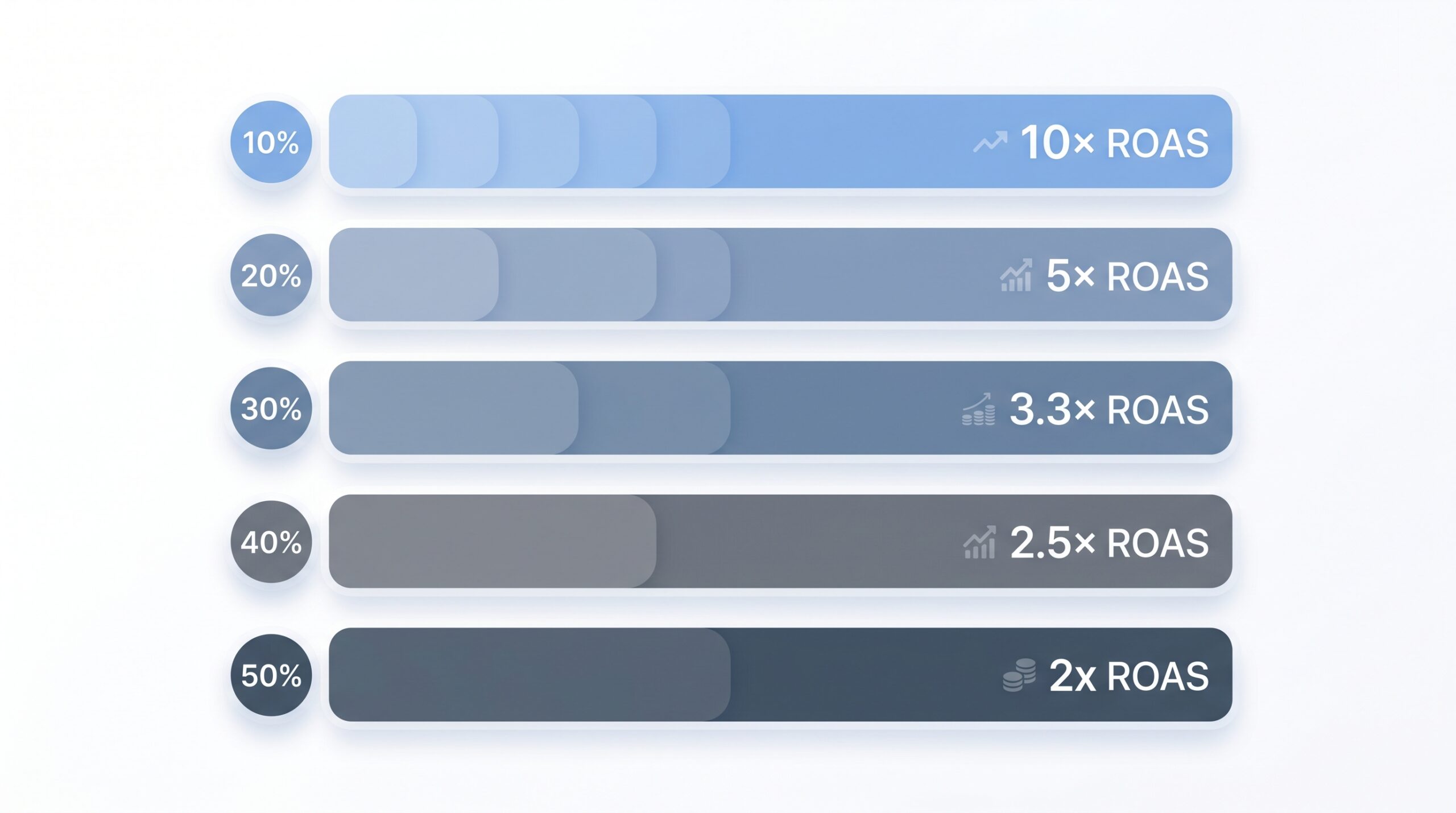
$50 - $30 - $10 = $10The ROAS you actually need (based on margins)
| Profit margin | Minimum ROAS needed |
|---|---|
| 10% | 10× |
| 20% | 5× |
| 30% | 3.3× |
| 40% | 2.5× |
| 50% | 2× |
Source: theshirlshirl.com
Why your ROAS might be low
- Weak offer: 5% off rarely excites anyone.
- Wrong audience: Great product, wrong people.
- Slow landing page: People bounce.
- Boring creative: Scroll. Scroll. Scroll.
- Confusing messaging: They don’t “get it.”
How to improve ROAS (without spending more)
1. Fix your landing page
- Make it faster
- Make it clearer
- Remove distractions
2. Improve your offer
- Bundles
- Free shipping
- Limited-time bonuses
3. Improve your creative
- Better hooks
- Real customer language
- Contextual product shots
4. Improve your targeting
- Exclude past buyers (if needed)
- Focus on lookalikes
- Stop targeting “everyone”

Source: theshirlshirl.com
ROAS vs MER
ROAS = channel-level performance
MER = whole-business efficiency
A simple beginner example
Meet Sarah. She sells candles.
- Cost per candle: $8
- Selling price: $25
- Ad spend: $100
- Revenue: $300
ROAS = 300 ÷ 100 = 3×She improves her offer → revenue jumps → ROAS improves.
Use the ROAS calculator
Try the ROAS Calculator to plug in your ad spend and revenue instantly.
FAQs
What is a good ROAS?
Generally 3× or higher, but it depends on your margins.
Is ROAS the same as ROI?
No. ROI includes all costs. ROAS only includes ad spend.
Can ROAS be too high?
Yes — it may mean you’re underspending and missing growth.
Should I optimize for ROAS or profit?
Always profit.
Does ROAS matter for brand awareness?
Not really. Those campaigns aren’t revenue-focused.
Photo credits
All images generated using Flow.
Source: theshirlshirl.com
Final Thoughts
ROAS looks complicated from the outside, but once you strip away the buzzwords, it’s just a simple ratio with a big job: telling you whether your ads are worth it.
Start by understanding your margins. Set a realistic ROAS target. Improve your offer, landing page, and creative — and watch how ROAS responds.
And when you’re ready to stop doing the math manually, let the ROAS Calculator do the heavy lifting.
Financial Information Disclaimer: All content published by Dr. Shirley Cheung is for informational and educational purposes only. Although the author draws upon corporate financial oversight experience, this content does not constitute professional financial, investment, legal, or tax advice. Readers should consult with a licensed Certified Financial Planner (CFP) or registered investment advisor before making any financial decisions.