
When You Do a Reverse Lunge, What Are You Actually Training?
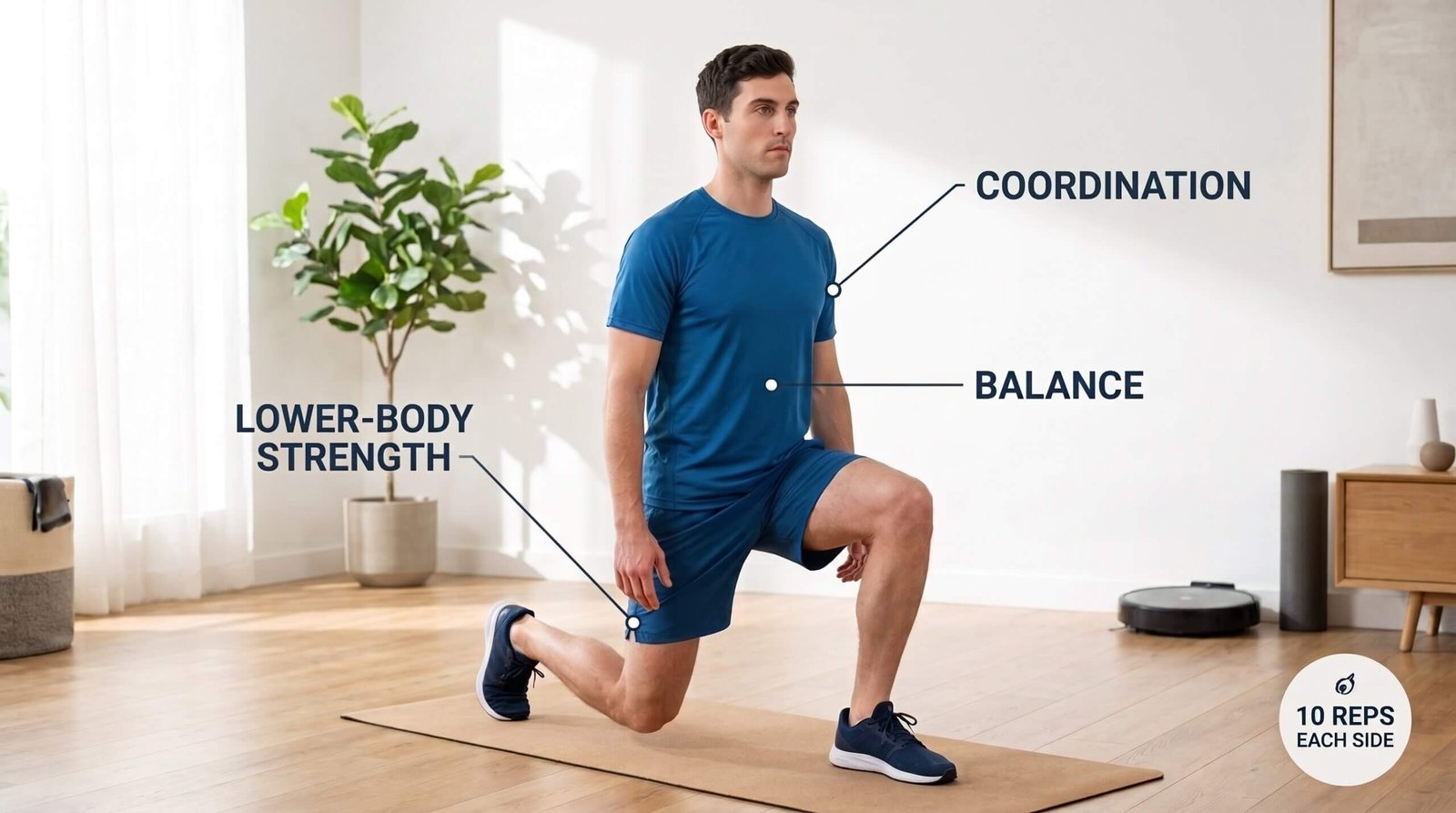
Adapted from a video on my PeakPhysic YouTube channel. Subscribe for more science‑backed fitness insights.
Watch the video above, then read on for the full breakdown of the muscles and movement patterns involved.
You may think a reverse lunge is just a leg exercise. But there’s more going on than that. A reverse lunge trains your glutes, quads, and hamstrings — but it also challenges your balance, stability, and coordination. Let’s break down exactly what’s happening.
⚠️ Disclaimer: This article is for educational and analytical purposes only. It does not constitute medical or fitness advice. Consult a qualified professional before starting any new exercise programme.
How to Perform the Reverse Lunge
- Stand tall with your feet hip‑width apart.
- Step one foot backwards onto the ball of the foot.
- Keep the back heel raised as you bend both knees.
- Lower your back knee toward the floor while keeping your front foot flat.
- Keep the front knee aligned with the front toes and your torso controlled.
- Push through the front heel and whole front foot to return to standing.
- Bring the back foot forward and repeat on the other side.
Think: Front heel down. Back heel up. The goal is a controlled range of motion while maintaining your balance and alignment.
What You’re Actually Training
Glutes
As you lower into the reverse lunge and return to standing, your front leg has to extend the hip. Your glutes are one of the main muscles helping produce that movement. So yes, the reverse lunge can be a very useful glute exercise. But the glutes aren’t working alone.
Quads
Your quadriceps — the muscles at the front of your thighs — are working too. They help control the descent as you lower your body, then they help straighten the knee as you come back up. Your front leg does two jobs: control the way down, drive the way back up. That’s how the exercise develops lower‑body strength through a full movement.
Hamstrings
The hamstrings also contribute to the movement. They help with hip and knee control as you move through the lunge. So although the reverse lunge may get a lot of attention as a glute exercise, it’s really a team effort across the lower body. Glutes. Quads. Hamstrings. All working together.
📊 Track your strength progress: Use our 1‑Rep Max Calculator to estimate your lower‑body strength, and Strength Standards to benchmark your lifts by age and gender.
Balance and Stability
A reverse lunge asks you to control your body while your feet are in a staggered position. Your ankle, knee, hip, and core all have to work together to keep you stable as you step back, lower, and return to standing. You’re not only building strength — you’re learning how to control that strength while moving.
Coordination
Think about what your body has to organise in one repetition: step backward, lower, control your balance, push through the front foot, return to standing. Your muscles, joints, and nervous system all have to coordinate that sequence. That’s one reason the reverse lunge is more than a simple leg‑strength exercise — you’re practising a complete movement pattern.
One Leg at a Time
Because the movement is performed one side at a time, each leg has to contribute independently. One side may feel stronger. One side may feel more stable. You may even notice that one side needs more control. That’s useful information. Train both sides consistently and pay attention to how each side feels.
Beginner Balance Assistance
If you need help with balance, perform the reverse lunge beside a sturdy chair and lightly hold the chair with one hand. Use the chair for balance while you learn the movement and build control. As your balance improves, gradually reduce the amount of support. The exercise stays the same — you’re simply progressing your ability to perform it independently.
The Bottom Line
The reverse lunge is simple to perform, needs very little space, and trains lower‑body strength, balance, and coordination. Try it today. Do 10 reps on each side and see how you feel. Commit to yourself and get 1% better each day. Train smarter, not harder.
📺 This article was adapted from a PeakPhysic video. Subscribe to PeakPhysic for more science‑backed fitness insights.
Related tools: 1‑Rep Max Calculator | Strength Standards | BMI Calculator | More articles: Analytical Living
Author: Dr. Shirley Cheung. This content is for informational purposes only and does not constitute professional fitness or medical advice.