
Where Does Fat Actually Go When You “burn it”?
Where Does Fat Actually Go When You Ask It to Leave?
Adapted from a video on my PeakPhysic YouTube channel. Subscribe for more science‑backed fitness insights.
Your friend asks, “Finished your gym workout? Did you manage to burn some fat?” And you’re thinking — great question. I definitely burned some calories, hope some fat too, but how did I actually burn it? Where did it go?
⚠️ Disclaimer: This article is for educational and analytical purposes only. It does not constitute medical or fitness advice.
The Two Physical Exits for Fat
When you exercise, the process raises your body’s demand for oxygen, and your body breaks fat down for fuel to meet that demand. The CO₂ you exhale afterwards is the byproduct of that. Fat gets broken down and leaves your body through two specific, physical exits: about 84% leaves through your lungs as carbon dioxide — you breathe it out. The other 16% leaves as water — sweat, urine, the usual routes [1].
Which raises the obvious next question: if breathing out fat is the exit, can you just breathe harder on purpose and skip the workout? Or even more embarrassing — does that mean when you fart, it helps too?
Killing Two Theories Right Now
No to the fart one first. That gas is your gut bacteria fermenting leftover food — hydrogen and methane — a completely different process, nothing to do with fat leaving your bloodstream. And no to breathing harder either. Hyperventilating blows off CO₂ already sitting in your blood; it doesn’t create any new fat breakdown. Breathing is the exit route, not the trigger. You still need the actual demand for oxygen that only real exertion creates.
Here’s a trickier version of that same question: what if you’re sitting down, but you breathe hard enough on purpose to get your heart rate into Zone 2 — does that count? Still no. Zone 2 isn’t really about your heart rate number; it’s about your muscles actually contracting and demanding fuel. Sitting still and forcing your breathing might spike your heart rate on a screen, but your muscles aren’t asking for energy, so there’s nothing pulling fat out of storage. You’d just make yourself lightheaded for nothing. Good try being creative though — still need to move more, exercise.
The FatMax Zone: Where Your Body Burns the Most Fat
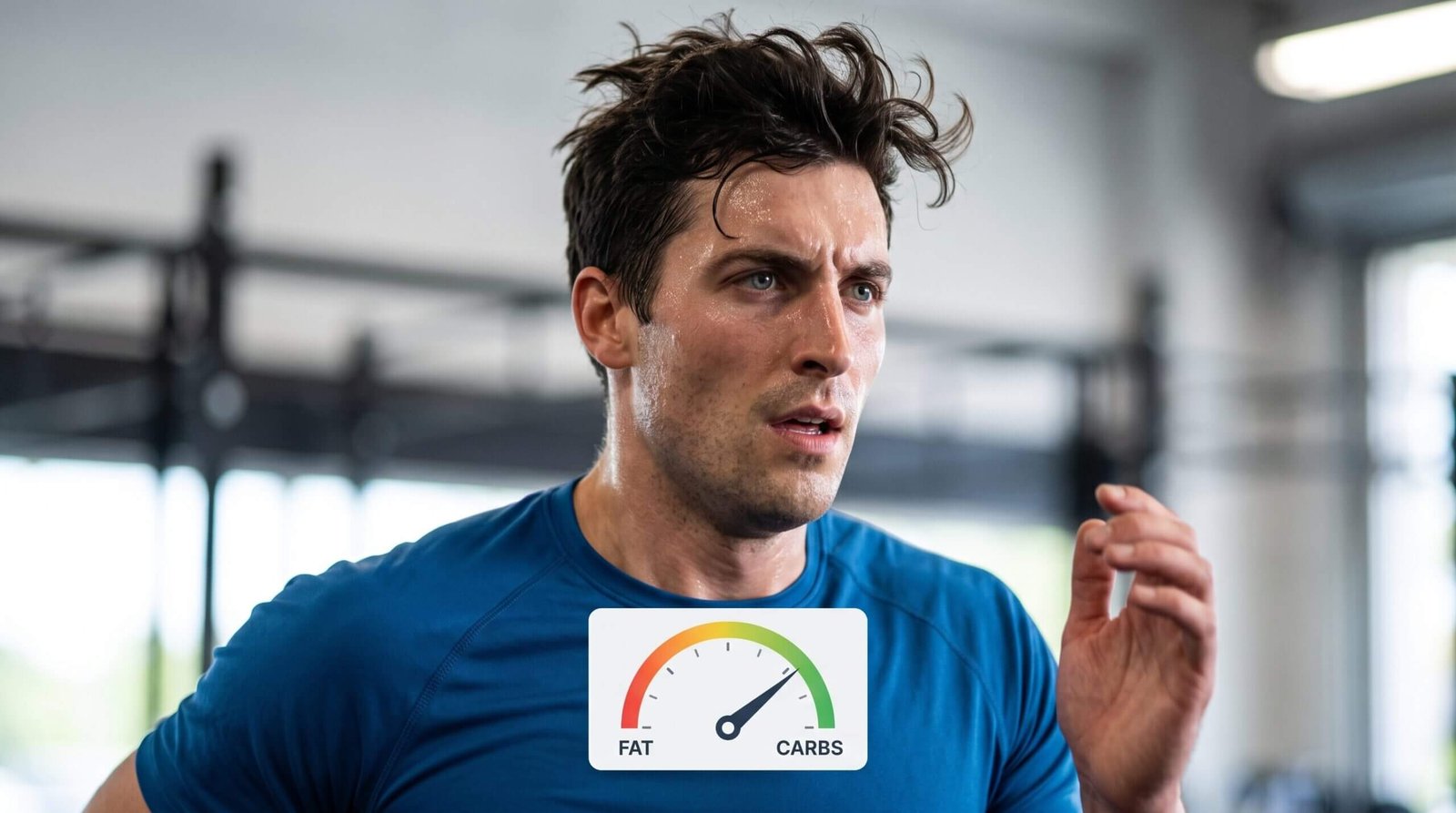
There’s a specific intensity where your body burns the highest percentage of fat as fuel. Sports scientists call it FatMax, and it sits at a moderate effort — roughly the pace where you can still hold a conversation but you’re working. That’s Zone 2 [4]. Push harder than that, and your body shifts toward burning carbs instead.
And your VO₂ max — your body’s capacity to take in and use oxygen — directly affects how much fat you can burn at any given intensity. Better aerobic fitness genuinely means a better fat‑burning engine, not just more stamina. Use our VO₂ Max Estimator and Heart Rate Zones Calculator to find your personal FatMax zone.
Why You Can’t Spot‑Reduce Fat (With Two Real Exceptions)
Since fat leaves your body through your bloodstream and your lungs — body‑wide, not from one local spot — now you understand why targeting one area doesn’t really work. A systematic review of 13 studies with over 1,100 participants confirmed that unilateral training doesn’t produce localised fat reduction [2].
But there are two genuine exceptions worth knowing.
One is belly fat — visceral fat. It’s stubborn for a real, specific reason. Fat cells in that area carry more of a receptor type that actively slows down fat release, plus that area responds more to cortisol and insulin, which both favour holding onto fat rather than letting it go [5]. That’s not about which ab exercise you do; it’s your hormones and your fat cells’ own biology working against you specifically there.
The other exception is a recent, smaller study. Researchers had people combine heavy ab‑focused endurance work with a lot of overall cardio, and found a modest, measurable localised effect [3]. It’s one result swimming against a much bigger pool of evidence saying no, so it’s worth knowing about — not worth building your whole plan around.
📊 Track your fat loss journey: Use our BMI Calculator and Body Fat % Estimator to measure progress. Pair with the Calorie Deficit Calculator to create the sustained deficit that actually drives fat loss.
The Bottom Line
A real, sustained calorie deficit. Consistent movement — ideally with some of that movement in your FatMax zone. And let your body decide the order it lets go. You can’t pick the order. You do get to control whether it happens at all.
So next time, when you realise you have lost fat, that means your body has effectively used the fat as fuel during some activities you have conducted — not because you breathe harder or you do ab crunches. Train smarter, not harder.
📺 This article was adapted from a PeakPhysic video. Subscribe to PeakPhysic for more science‑backed fitness insights.
📚 Sources
- Meerman R, Brown AJ. When somebody loses weight, where does the fat go? BMJ (2014).
- Systematic review and meta‑analysis of unilateral training and localized fat reduction (13 studies, 1,158 participants).
- Brobakken MF et al. Abdominal aerobic endurance exercise reveals spot reduction exists: a randomized controlled trial. Physiological Reports (2023).
- FatMax / VO₂ max fat oxidation research (INSCYD whitepaper; Zone 2 training physiology reviews).
- Alpha‑2 adrenergic receptor density, cortisol, and insulin resistance in visceral/abdominal fat (Obesity Reviews; multiple sources on stubborn fat physiology).
Related tools: BMI Calculator | Body Fat % Estimator | Calorie Deficit Calculator | VO₂ Max Estimator | Heart Rate Zones | More articles: Analytical Living
Author: Dr. Shirley Cheung. This content is for informational purposes only and does not constitute professional fitness or medical advice.
Health & Fitness Disclaimer: The information presented in this article is data-driven and intended for educational purposes only. It is not a substitute for professional medical advice, diagnosis, or treatment. Always consult with a qualified physician or healthcare provider before beginning any new exercise regimen, diet, or lifestyle shift.