
100 Bodyweight Squats: What Your Body Is Telling You at Every Rep
100 Bodyweight Squats: What Your Body Is Telling You at Every Rep
Adapted from a video on my PeakPhysic YouTube channel. Subscribe for more science‑backed fitness insights.
We’re going to do 100 bodyweight squats together — but this isn’t just a challenge. I want you to notice what your body is actually doing from rep 1 to rep 100. I’ll tell you what’s happening in your muscles, joints, and nervous system at each phase, and how to protect your knees and tendons while you’re here.
🧘 Setup: Feet shoulder‑width apart, toes slightly out. Think about this: you sit between your heels, not onto your knees. If your knees or tendons feel sharp pain at any point, shrink your depth or pause. Discomfort is okay; pain is a stop sign.
Reps 1–10: The Baseline
Right around rep 10, it should still feel easy. That “easy” feeling means your nervous system is running a well‑learned movement pattern. Your quads, glutes, and hamstrings are sharing the load without needing a big effort from your higher‑threshold muscle fibres yet. Notice how stable your knees feel right now. The quad tendon and patellar tendon are just cycling in tension — nothing dramatic. This is where we lock in good form, because this same pattern needs to hold when you get tired.
As you squat, track your knees in line with your toes, not collapsing inward. If you feel any knee pressure now, adjust: push the hips slightly back more and keep your weight spread through the whole foot.
Reps 10–20: Warm‑Up Window
By rep 20, you might feel warmed up — thighs awake, but not burning. That’s your muscles doing the same work with very efficient recruitment: not many fibres are close to their limit yet. Use this window to check your knees. If they’re feeling good now, keep this same knee path later when you’re tired. If they’re annoyed, fix it now — don’t wait for rep 70.
Keep your heels grounded. If they’re popping up, shorten your depth a little rather than forcing the ankles. Chest softly lifted — think long spine rather than “upright torso.”
Reps 20–40: The Burn Begins
At around rep 40, most people start feeling that classic quad burn. What’s really happening is simple: more of your muscle fibres are firing at once to keep moving your same bodyweight, and the sustained tension makes your nerves report more “heat” and “burn.” You may notice the front of your knees or the area just above the kneecap feeling warm or pressured. That’s the quad and patellar tendons handling repeated tension with less cushioning from fresh muscle.
Let’s do a check‑in right now: Do your quads feel hot and heavy? Do your knees feel more “pressured” than they did at rep 10? If yes, that’s expected — but we protect them with better control, not more speed. Slow your lowering. Control down, stand up with purpose. Rushing the bottom makes the tendons catch more of the force. If your knees feel sharp, cut depth by 10–20%, but keep the same clean knee tracking.
Reps 40–60: The Shake Zone
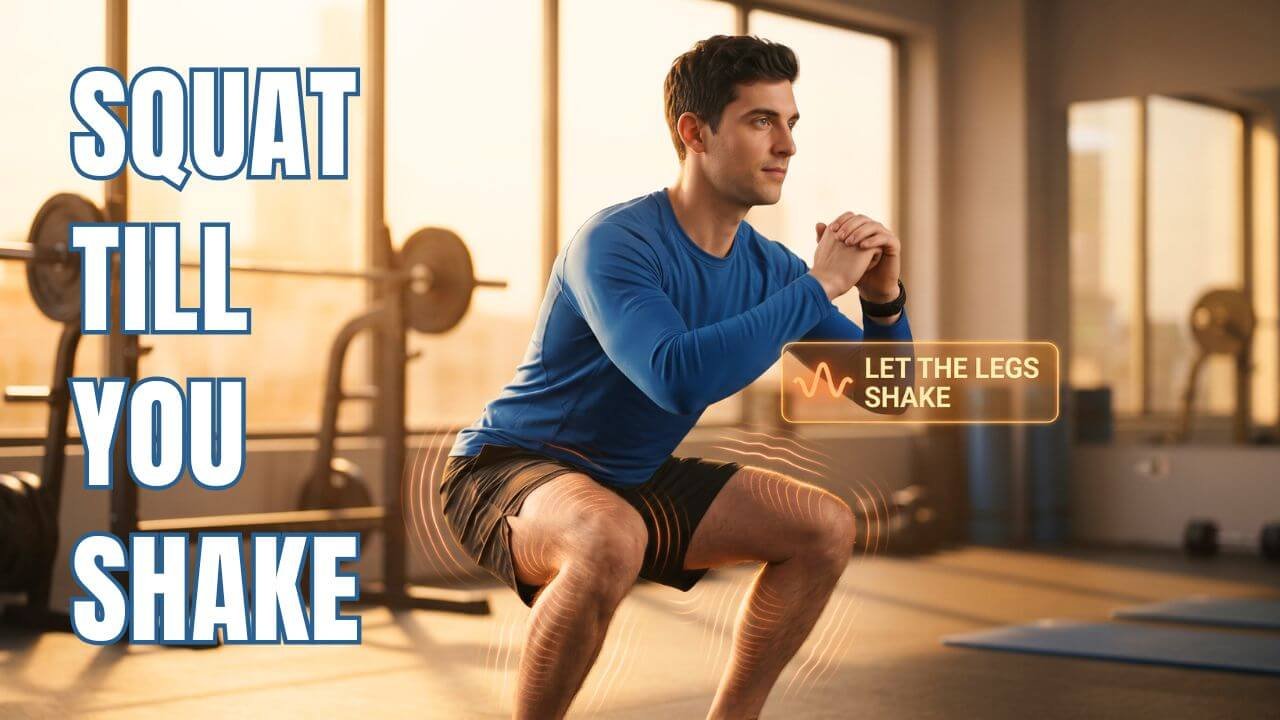
Somewhere around rep 60, you might feel your legs starting to shake. That shaking isn’t weakness — it’s your nervous system trying to keep the movement going by rapidly switching muscle fibres on and off as others get tired. Balance might feel less automatic here. Your hips and ankles are working harder to keep you over your feet, and your stabilising muscles around the knee are doing more emergency work.
If your thighs are trembling, notice it — but don’t panic. Keep your eyes on one spot in front of you, keep your feet planted, and let the legs shake while you slow the movement. If the shake makes you feel unstable, reduce your range: think “comfortable squat” instead of “deep squat.” Avoid suddenly dropping faster to “get it over with” — that’s when the tendons get hit with ugly, spiky loads.
Reps 60–80: Compensation Patterns Emerge
At about rep 70, watch what your body tries to do. You might lean more forward or shift the work from your knees into your hips and lower back. That’s your system trying to protect your tired quads by changing the strategy. This is also the danger zone for knees. As your thighs fatigue, your body may let the knees cave inward or slide too far forward, loading the patellofemoral joint and the tendons more than they like.
Ask yourself right now: Are my squats quietly turning into good‑mornings, with the chest dropping? Are my knees still tracking over my toes, or collapsing in? If you feel your chest diving down, hinge less and think: “sit between my heels, not over my toes.” If your knees are knocking inward, slow down and gently push them out to match your toes. If you can’t control it, that’s your cue to shorten range or pause.
Reps 80–95: The Survival Zone
By rep 80, you’re probably flirting with your current endurance limit. Your body’s priority shifts from “good squat” to “just stand up.” That’s when we consciously choose form over ego. Your quads are close to their temporary ceiling, so your nervous system may try anything — extra hip snap, extra back extension — to keep you moving.
Now, do a quick scan: Are you holding your breath and grinding? Do you feel your lower back kicking in more than your legs? If yes, this is your reminder: small, clean squats count more than big, messy ones. Let your depth be self‑regulated — if clean form only exists at a half squat now, stay there. You already earned your load through the earlier reps. Exhale as you stand. Don’t lock the breath and jerk out of the bottom.
At rep 95, these are survival reps. Your body is near its limit for this session, and you may feel like your legs just don’t respond the way they did at rep 10. This is where people often let the lower back take over when the quads check out — arching up out of the bottom. For your knees and tendons, we don’t need hero depth here. We need clean exits. If every rep feels like a negotiation, listen to that. You should feel tired, maybe burning, but not stabbing joint pain. If your back is doing more than your legs, cut depth down and think of this as a “finish line shuffle” — small reps, good alignment. If the knees feel pinchy or sharp, stop at 95. You don’t “fail” a set by protecting your joints; you succeed by living to train another day.
Rep 100: The Aftermath
When you hit rep 100, notice your legs. They’ll feel heavy, maybe slow, like you’re wearing weights. That’s the after‑effect of high tension and repeated loading — your muscles and tendons are still settling down. Your breathing will stay elevated for a bit, and that burn in the thighs can hang around even after you stop. That’s your nervous system and sensory receptors still reporting the stress your tissues just went through.
Stand tall, shake the legs gently, and notice the difference between tired muscle and angry joints. Tired muscle feels heavy, hot, and full. Angry joints or tendons feel sharp, stabby, or pinpoint. If your knees feel like a dull ache, that’s usually just the tendons and joint surfaces reminding you they did work. If it’s sharp or increases as you walk, that’s your body asking for more recovery and less depth or fewer reps next time. Walk around, let the legs swing, don’t immediately sit with knees locked at 90°. Give them a minute to decompress.
📊 Track your fitness progress: Use our BMI Calculator to monitor body composition changes as your leg strength improves, or the Calorie Deficit Calculator to see how endurance training fits into your energy balance.
The Bottom Line
Today wasn’t just 100 squats. It was 100 chances to listen to your body under load. At rep 10, you learned your baseline. At 40, you felt the work. At 70 and 95, you saw your compensation patterns. And at 100, you practised stopping at tired, not at injury. That’s how you build lower‑body endurance and protect your knees and tendons — for life, not just for this workout.
📺 This article was adapted from a PeakPhysic video. Subscribe to PeakPhysic for more science‑backed fitness insights.
Related tools: BMI Calculator | Calorie Deficit Calculator | More articles: Wellness
Health & Fitness Disclaimer: The information presented in this article is data-driven and intended for educational purposes only. It is not a substitute for professional medical advice, diagnosis, or treatment. Always consult with a qualified physician or healthcare provider before beginning any new exercise regimen, diet, or lifestyle shift.