
Don’t Give Up on Push-Ups: Try This Progression Instead
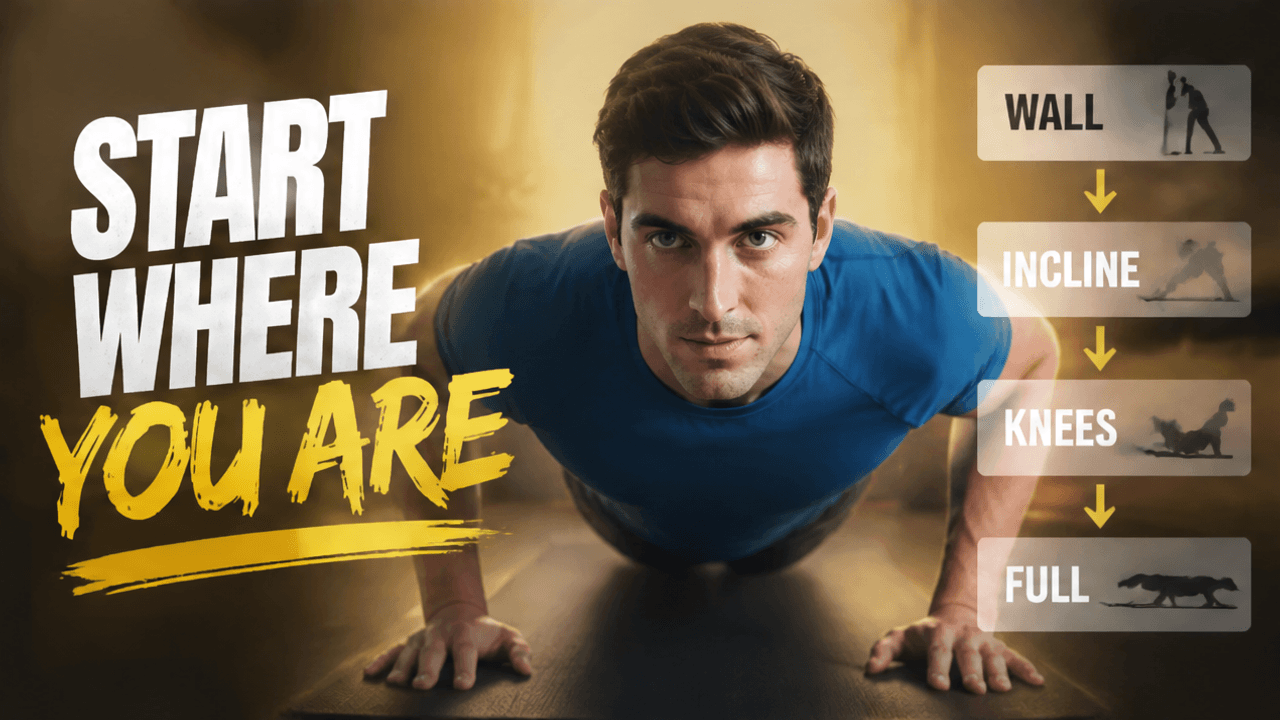
Can’t do a full push-up yet? You’re not broken. You’re just untrained. Arms shake on rep one. Hips sag before your chest moves. Face meets floor. Most people stop here. And yes, plenty of adults can’t do 10 clean push-ups. That’s fine. Today, you start where you actually are, not where your ego wishes you were.
Push-ups are worth mastering. They work your chest, shoulders, triceps, and core with zero equipment. They teach your whole body to move as one unit. They also make everyday pushing movements easier — from getting off the floor to pushing open a heavy door. And they scale. That’s the whole point. You don’t need to be strong to start. You just need a level you can do with good form.
⚠️ Disclaimer: This article is for educational and analytical purposes only. It does not constitute medical or fitness advice. Consult a qualified professional before starting any new exercise programme.
The Progression Ladder
Start here: the alternating push-up. Lower down like a real push-up — chest toward the floor, body straight. Then come back up onto your knees. Still too much? Drop to knee push-ups. Knees on the ground. Hands shoulder-width. Body straight from head to knees. Lower until your chest nearly reaches the floor. Push back up. Keep your hips in line.
Watch the video above to see the full progression in action.
This is where a lot of people get stuck. They can crank out dozens of sloppy knee push-ups but still can’t do one clean full rep. Why? Because the jump in load is real. Knee push-ups put less load through your arms than a full push-up. A full push-up asks you to support substantially more of your bodyweight. That’s why the progression matters.
If knee push-ups are still too much, move to incline push-ups. Find something sturdy — a bench, desk, or counter. Hands on the surface. Body straight. Lower your chest toward the edge. Push back. The higher your hands, the easier it gets. Your chest, shoulders, and arms are still working, just with less load.
Still too much? Raise the surface. Chest height. High counter. High table. Same movement. Less load. And if that’s still too much, start at the wall. Stand facing a wall. Hands at about shoulder height and shoulder width. Step back. Lean in until your chest gets close to the wall. Push back out. You might think, “This is too easy.” Fine. Master it first. The wall is where you start building the movement.
📊 Track your strength progress: Use our Strength Standards to benchmark your push-up progression, or the 1‑Rep Max Calculator to estimate your upper-body strength.
How to Progress Without Wasting Months
Pick the level where you can control the entire rep with good form. Not the level you wish you were at. The level you are actually at. Work for three sets of 8 to 10 clean reps, two to three times a week. Not every day. Your muscles need recovery too.
Once you can hit three sets of 12 with full range, no sagging hips, and no bouncing, move up one level. Not almost 12. Clean 12. And don’t worry if your timeline is different from someone else’s. Some people progress quickly. Others take longer. That doesn’t matter. Consistency does.
Form Rules That Keep You Moving
- Keep your body straight from head to feet — or head to knees on knee push-ups.
- No sagging hips. No butt in the air.
- Go through a full, comfortable range of motion. Lower under control. Then push back up.
- Don’t drop and bounce.
- Keep your elbows tracking back rather than flaring straight out to the sides.
- Keep your core braced and your glutes engaged.
- Keep your neck neutral. Chest moves toward the floor — not your chin.
Wrist bothering you? Adjust your hand position slightly or use a push-up handle or fists if that feels more comfortable. Core giving out before your chest? That’s a sign you also need to work on your bracing and body control. Remember: you don’t start at the final level. You build your way there. Master one level. Then level up.
The Bigger Picture
Push-ups are one movement. But they’re worth mastering because they teach a bigger skill: how to control your whole body while producing force. Your chest works. Your triceps work. Your front shoulders work. Your core works to keep everything connected. And as you move from the wall toward the floor, you gradually ask your body to handle more load. That is the progression.
Start where you are. Master the level. Build the strength. Then move up. So if you can’t do a full push-up today, that’s okay. You have a ladder now. Wall. Incline. Knees. Full push-up. One level at a time.
The Bottom Line
Commit to yourself and get 1% better each day. Train smarter, not harder.
📺 This article was adapted from a PeakPhysic video. Subscribe to PeakPhysic for more science‑backed fitness insights.
Related tools: Strength Standards | 1‑Rep Max Calculator | BMI Calculator | More articles: Analytical Living
Author: Dr. Shirley Cheung. This content is for informational purposes only and does not constitute professional fitness or medical advice.

Dr. Shirley CheungtheshirlshirlEdit Profile