
What Happens to Your Body When You Do a Farmer Carry?
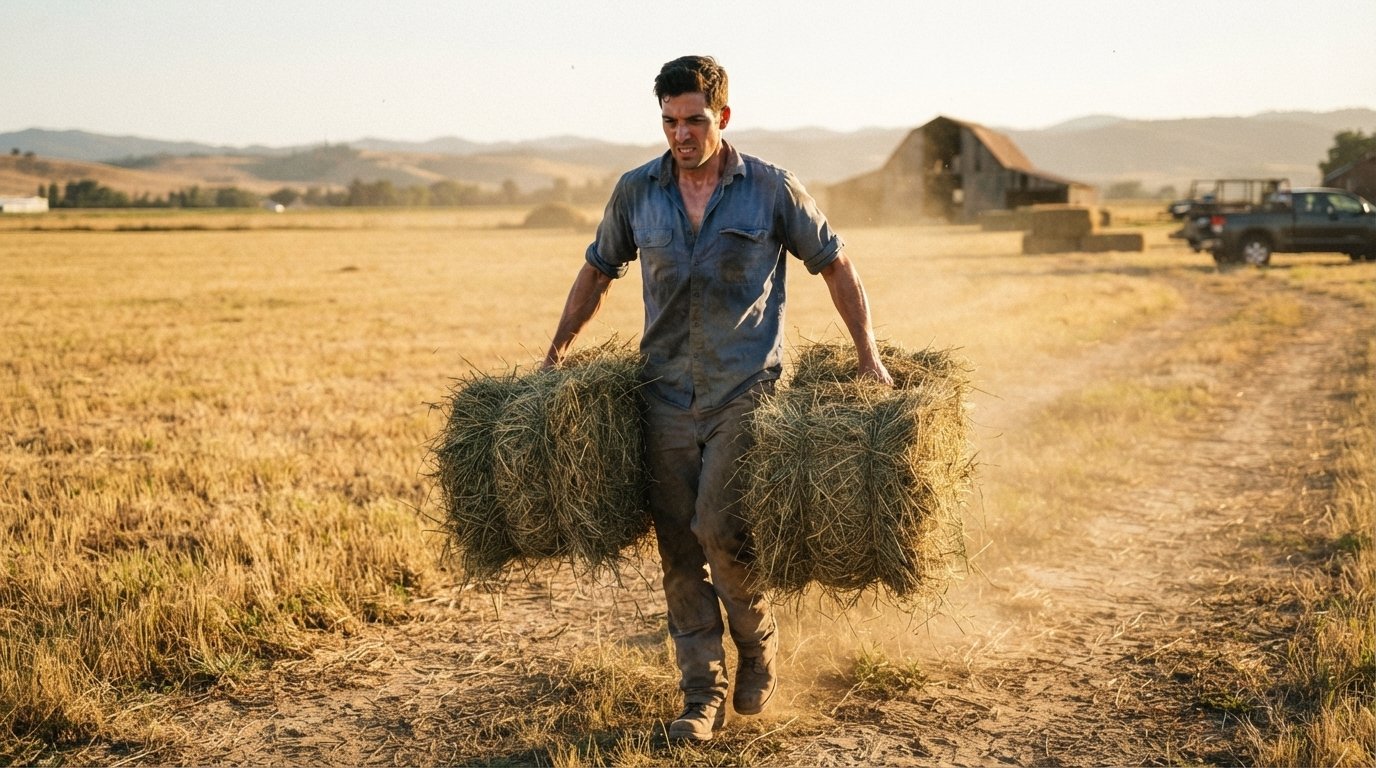
Some people picture a farmer carrying hay rolls across a field. Some picture a strong guy in the gym walking around with heavy kettlebells. That image is not wrong. The same idea shows up in real life too — with a suitcase, shopping bags, or anything heavy you carry while walking. That is where the farmer carry becomes interesting: a simple movement, a real-world challenge, and a very practical way to train strength for daily life.
⚠️ Disclaimer: This article is for educational and analytical purposes only. It does not constitute medical or fitness advice. Consult a qualified professional before starting any new exercise programme.
What Is a Farmer Carry?
A farmer carry is simple: you pick up a weight in each hand and walk. That can be dumbbells, kettlebells, heavy bags, or even a suitcase if that is what you have at home. The point is not to make it complicated — the point is to hold something heavy at your sides and move with control.
That walking part matters. If you just stand there holding the weights, that is a different exercise. Once you start walking, your body has to do more than grip the load. It has to stay balanced, stable, and organised with every step.
Watch the video above to see the movement in action.
What Does It Train?
A farmer carry trains your grip, forearms, core, lower back, shoulders, and walking control.
Grip and forearms. Your hands are working the whole time. You are squeezing the handles continuously so the weight does not slip. That is why farmer carries are one of the most direct ways to train grip endurance.
Core and lower back. This is not a crunch. It is not a bend-and-twist exercise. It is a stability exercise. Your trunk muscles are bracing so your body does not lean, collapse, or rotate as you walk. Your lower back is part of that system too.
Shoulders and upper back. They help keep the load organised while your arms hang by your sides. You do not want to shrug hard or let everything slump downward.
Legs. You are still walking, after all. So your hips, thighs, and calves are helping you move forward while carrying the load.
What makes the farmer carry useful is that it is not just one muscle doing one job. It is your whole body having to stay coordinated under load.
What Is Happening Inside the Body?
A farmer carry is mostly a stability challenge under tension. Your muscles are not moving through a huge range of motion. They are creating force to keep your body from moving the wrong way. Your grip muscles are squeezing. Your trunk muscles are bracing. Your shoulders are supporting. Your legs are stepping. And all of that is happening at the same time.
That is why the exercise can feel harder than it looks. Your breathing also starts to work harder, especially if the load is heavy or the carry goes on for a while. Your heart rate goes up because more muscle mass is active at once. So even though this is not a classic cardio exercise, it can still feel very demanding.
📊 Track your progress: Use our Strength Standards to benchmark your overall strength, or the 1‑Rep Max Calculator to estimate your grip and upper-body potential.
Why It Matters in Real Life
This is where the farmer carry becomes really practical. Think about carrying groceries. Think about dragging a suitcase through an airport. Think about holding laundry, boxes, water jugs, or awkward household items.
That is the same broad skill: hold something heavy, stay upright, keep walking, do not let your body twist or lean. That is real-world strength.
A farmer carry will not copy every daily task exactly. A suitcase is not the same as a dumbbell. A grocery bag is not the same as a kettlebell. Still, the body pattern is similar enough to matter. That is why this exercise fits ordinary adults so well. You do not need to be an athlete to use it — you just need to want to carry things better.
How To Do It
A good farmer carry should look controlled.
- Start by standing between your weights.
- Bend down with a neutral back and pick them up smoothly.
- Once you stand, keep your chest tall without over-arching your lower back.
- Let your arms hang naturally by your sides.
- Walk with steady, controlled steps.
Do not rush. Do not sway side to side. Do not shrug up hard. Think about staying tall and quiet through the trunk. When you finish, lower the weights with control — do not just drop them.
How Heavy Should You Start?
There is no perfect universal beginner weight. A good starting point is a load you can carry for about 10 to 20 seconds with clean posture and steady breathing. It should feel challenging. It should not feel messy.
If your shoulders hike up, your steps get choppy, or your torso starts leaning, the load is probably too heavy for now. If it feels too easy, you can gradually increase the weight, the time, or the distance. Just do one thing at a time.
How Often Should You Do It?
For most beginners, you do not need to do farmer carries every day. A simple starting point is:
- 2 to 4 sets
- 10 to 20 seconds each
- 1 to 3 times per week
That is enough to practise the movement and build capacity without turning it into a grip-failure contest. You can do more later if you want. You do not have to start there.
Can You Do It At Home?
Yes. You do not need gym equipment. You can use dumbbells, kettlebells, grocery bags, backpacks, water jugs, suitcases, or sturdy household containers. If you are using improvised loads, just make sure the handle is secure and the object will not swing around or break. A hallway works fine too — you can walk down, turn slowly, and come back. That is enough space for a basic carry.
Farmer Carry vs Suitcase Carry
A farmer carry means weight in both hands. A suitcase carry means weight in only one hand. That changes the challenge. With a farmer carry, your body stays upright under symmetrical load. With a suitcase carry, your trunk has to resist being pulled sideways.
So the suitcase carry is not just a smaller version — it is a different challenge. If the farmer carry feels solid, the suitcase carry can be a nice next step.
Common Mistakes
The biggest mistake is going too heavy too soon. That usually leads to shrugging, leaning, choppy steps, breath-holding, grip failure, or dropping the weights. Another mistake is trying to move fast just because you are carrying something. Faster is not better if your posture falls apart.
The goal is simple: walk with control, stay organised, keep the load steady.
The Bottom Line
A farmer carry is one of the simplest ways to train grip, forearms, core, lower back, and practical carrying ability at the same time. It is not flashy. It is not complicated. It is one of those exercises that makes sense the moment you connect it to real life. And that is why it works.
Train smarter, not harder.
📺 This article was adapted from a PeakPhysic video. Subscribe to PeakPhysic for more science‑backed fitness insights.
Related tools: Strength Standards | 1‑Rep Max Calculator | BMI Calculator | More articles: Analytical Living
Author: Dr. Shirley Cheung. This content is for informational purposes only and does not constitute professional fitness or medical advice.