
What Does Bird Dog Actually Train?
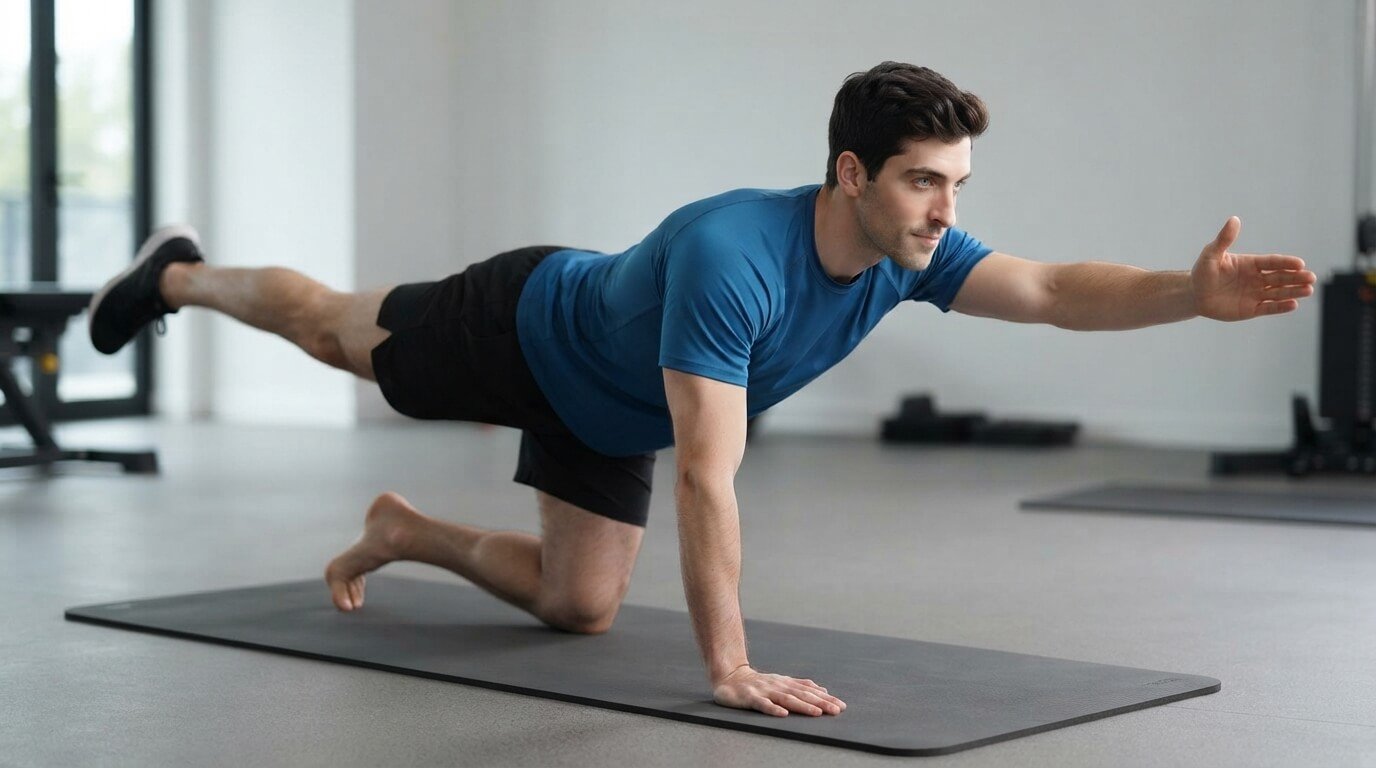
If you have ever been told to do a bird dog and quietly wondered what it is actually for, you are not alone. It looks like the easiest exercise on the floor. You are not even standing up, and nothing is burning. So what is it actually doing that earns it a place at the start of so many beginner programs? The answer is more useful than the movement looks, and it changes how you will do the drill from your very first rep.
⚠️ Disclaimer: This article is for educational and analytical purposes only. It does not constitute medical or fitness advice. Consult a qualified professional before starting any new exercise programme.
What the Bird Dog Actually Asks of You
The bird dog exercise is not really a strength exercise in the way a squat is. It is a control exercise. The moment you reach your right arm forward and your left leg back, your body has a job to do. It has to keep your spine and your pelvis steady while two limbs are moving away from your centre. That is the whole point of the drill.
And it is how most of your day actually works. You carry a bag of groceries in one hand. You reach for something on a high shelf while standing on one leg. You step off a curb. In every one of those moments, part of your body is moving, and another part needs to stay still. The bird dog is practice for exactly that.
Watch the video above to see the movement in action.
How to Set It Up
First, start on all fours. Hands directly under your shoulders, knees directly under your hips.
Before you move anything, notice your weight. You want it spread evenly across both hands and both knees. Now here is the part people skip: find a neutral spine. That means your back is not arched up and it is not sagging down. Imagine there is a glass of water resting on your lower back and you do not want to spill it.
Now reach your right arm forward, thumb up, and at the same time reach your left leg back — only as far as you can go without spilling the glass. Think about this: long arm, long leg, hips level, ribs down. Then bring them back to the floor slowly, and switch sides.
If your hips roll open or your lower back dips, you have gone too far. That is not a failure. That is information.
The Mistake Most People Make
Here is what most people don’t know: the bird dog is neither a lift nor a stretch. The moment you chase height, your brain starts using bigger muscles to get the job done, and the small stabilisers you came here to train stop working. So the leg goes higher, the hips twist, and it feels like more. It is actually less.
The fix is uncomfortable for the ego and simple for the body: shorten the range. If you can only reach your arm halfway before your hips move, then halfway is your bird dog today. You are not training the reach. You are training what happens in your trunk while you reach. Keep the position square, and slow the movement down to three or four seconds each way. Slow is not easier. Slow is the exercise.
📊 Track your progress: Use our Strength Standards to benchmark your core and lower-body strength, or the BMI Calculator to monitor body composition changes.
What It Trains — and What It Does Not
So what is actually working?
- Transversus abdominis: Your deep abdominal wall, the muscles that wrap around your middle like a corset.
- Obliques: Which resist the twist that wants to happen when one side of your body reaches out.
- Multifidus: The deep spinal stabilisers that help hold one segment of your spine steady while the rest of you moves.
- Glutes: On the back leg, plus the muscles around your shoulder blade on the arm side.
Now let’s remove some of the hype. A bird dog is not a treatment for back pain, and it is not a cure for poor posture. The evidence on core work for back pain is limited and mixed, and it is not clearly superior to other forms of active exercise over the long term. That does not make this drill useless. It makes it one honest piece of a core stability programme — and it means nobody should be selling you a thirty-day fix.
Making It Practical
If the standard version feels wobbly, start with the arm only. Reach your right arm forward, hold for a breath, bring it down, and do six on each side. When that feels steady, add the leg. If you want more support, keep one hand on a chair, or rest your shin on a rolled towel instead of your knee.
If it feels too easy, slow it down before you make it harder — five seconds out, five seconds back. When five slow reps per side feel controlled, you can add an elbow-to-knee touch underneath your body or lift the back knee slightly off the floor.
As for dose: two or three sets of six to eight reps per side, two or three times a week, is plenty. More is not better here.
The Bottom Line
Try this today. Before you touch anything else, get on the floor and do six slow bird dogs on each side. Pay attention to whether your hips stay level, because that one detail tells you more about your control than any number of reps will.
And if you have already tried the dead bug, this is its natural partner. The dead bug teaches you to hold your trunk steady while your limbs move in front of you. The bird dog teaches you to hold your trunk steady while your limbs reach away. Same skill, two directions.
So, which one feels wobbly for you — the hip or the shoulder? Commit to one small thing, get one per cent better, and train smarter, not harder.
📺 This article was adapted from a PeakPhysic video. Subscribe to PeakPhysic for more science‑backed fitness insights.
Related tools: Strength Standards | BMI Calculator | Waist-to-Hip Ratio | More articles: Analytical Living
Author: Dr. Shirley Cheung. This content is for informational purposes only and does not constitute professional fitness or medical advice.