
Newbie Gains: Why You’re Stronger but Look the Same
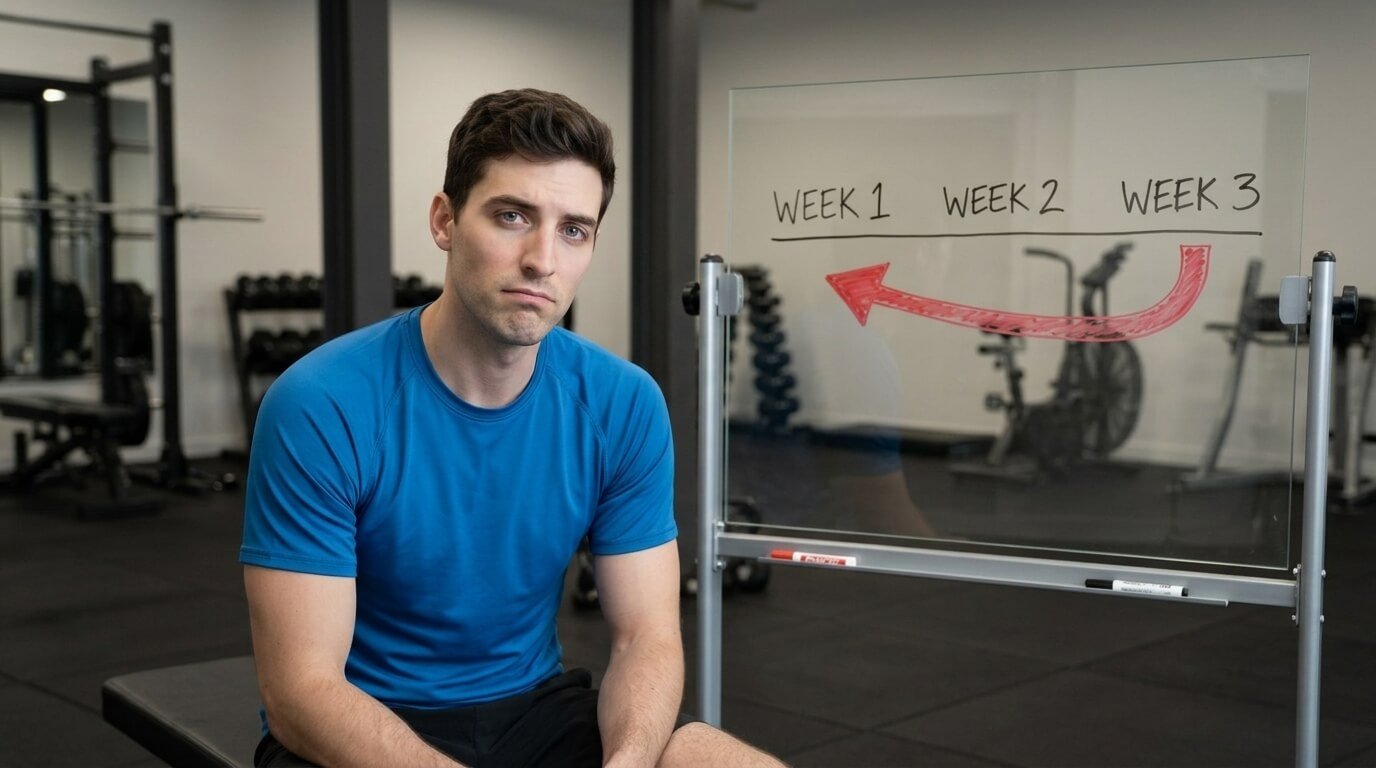
Hey mirror, where are my two packs? I’m not asking for a lot. I’m not even asking for a six-pack. I worked out so hard for the past two weeks and nothing — not even one extra muscle. Where is that lean muscle?
So you stand in front of the mirror, expecting to see the change. And you see the same person looking back at you. No new lines. No new shape. Nothing. That gap between what you can do and what you can see is one of the most discouraging parts of early training. Most people read it as a sign it’s not working, that their body is different, that they’re doing it wrong.
None of that is true. Your body is simply spending its first few weeks on something you cannot see. And it will not spend a single calorie on building tissue until that work is done.
⚠️ Disclaimer: This article is for educational and analytical purposes only. It does not constitute medical or fitness advice. Consult a qualified professional before starting any new exercise programme.
The First Two Weeks Are a Software Update
To understand why the mirror looks empty early on, you have to understand what building muscle costs. It’s expensive. It takes calories, protein, and energy your body would rather hold in reserve. Your body doesn’t spend that kind of resource on a whim. It needs proof the investment is worth it.
So before it builds anything, it does something cheaper. It makes better use of the muscle you already have. Think of it like a small team of workers. In the first week or two, your body isn’t hiring new people. It’s getting the people already on the job to work faster and coordinate better. Same team. Same muscle. Completely different output.
Your nervous system learns to switch on more muscle fibres, fire them more quickly, and time them together so the whole muscle pulls as one. You feel stronger almost immediately, because you are genuinely stronger. You’re just stronger because of better instructions, not because of bigger muscle.
Watch the video above for the full breakdown.
This is why beginners can add weight so fast at first, and then suddenly stall a few weeks later. There’s a limit to how much better your nervous system can coordinate the muscle you already have. Once your nervous system hits that ceiling, it has nowhere left to go. And that is the exact moment your body is forced to switch to actually building new muscle tissue.
Why Week Three Feels Like a Step Backwards
Week three feels like a step backwards because the easy strength gains slow down. But you’re sore in a way you weren’t before. Your legs feel heavy. And the mirror still shows you nothing new. Three things are happening here, and none of them mean what they feel like.
- Soreness. That’s microtrauma — tiny amounts of damage to the muscle fibres from working them harder than they’re used to. It’s the signal your body responds to.
- Inflammation. Your body sends fluid and repair cells to the area, making the muscle feel tight and full.
- Fluid inside the muscle. Muscle stores energy as glycogen, and for every gram of glycogen, it holds about three grams of water. Train hard, and it stores more of both. So your thigh can genuinely be heavier and measurably larger on a tape measure, and still look exactly the same in the mirror, because the change is fluid, not tissue.
There’s a fourth factor, too: your tendons. They connect muscle to bone, and they get less blood flow than muscle. That makes them the slowest link in the chain early on. Your muscle adapts first. Your tendons catch up later. So don’t lift heavier right away just because your muscles feel ready. Add load gradually and let your tendons catch up.
The Week Your Body Stops Being Efficient and Starts Building
Somewhere around weeks four to six, your nervous system has already optimised the existing muscle you have. Your workouts have mostly stopped improving your strength, and progress starts to flatten. But you are still asking your body to do more than it could before. It can no longer keep up with the demand. So it answers by increasing muscle size.
Here is the reason. Every muscle fibre is wrapped in a membrane. When that membrane is put under mechanical tension, it acts like a sensor. Tension is the signal. The signal tells the cell that there is a demand here that isn’t going away. The cell then responds by calling in satellite cells.
Satellite cells are dormant cells that sit alongside the muscle fibre, waiting to act when called. When they’re called, they donate their nuclei to the fibre, and those nuclei are what allow the muscle to produce more protein and add actual contractile material. That is the moment the tissue gets bigger, not just more switched on.
📊 Track your progress beyond the mirror: Use our Strength Standards to benchmark your lifts, and the 1‑Rep Max Calculator to see measurable strength gains that the mirror can’t show yet.
Progression Awareness
Let’s put the timeline together. In weeks one to three, your strength is neurological. It’s coordination, recruitment, and timing. From week four onward, your growth is structural. It’s nuclei, protein, and tissue.
So give the whole thing six to eight weeks before you judge it by how you look. Keep your protein high enough to give your body the material it needs. Add load gradually, and let your tendons keep pace.
Understanding the progression that is happening in your body helps more than looking purely into the mirror. Look again after six to eight weeks.
The Bottom Line
The mirror is a lagging indicator. Your nervous system adapts in days. Your tendons adapt in weeks. Your muscle tissue adapts in months. If you judge your first two weeks by what you see, you will quit before the part that actually matters begins.
Trust the process, track your strength, and train smarter, not harder.
📺 This article was adapted from a PeakPhysic video. Subscribe to PeakPhysic for more science‑backed fitness insights.
Related tools: Strength Standards | 1‑Rep Max Calculator | BMI Calculator | More articles: Analytical Living
Author: Dr. Shirley Cheung. This content is for informational purposes only and does not constitute professional fitness or medical advice.