
Should You Work Out While Sore? What the Science Says
Should You Work Out While Sore? What the Science Says
Adapted from a video on my PeakPhysic YouTube channel. Subscribe for more science‑backed fitness insights.
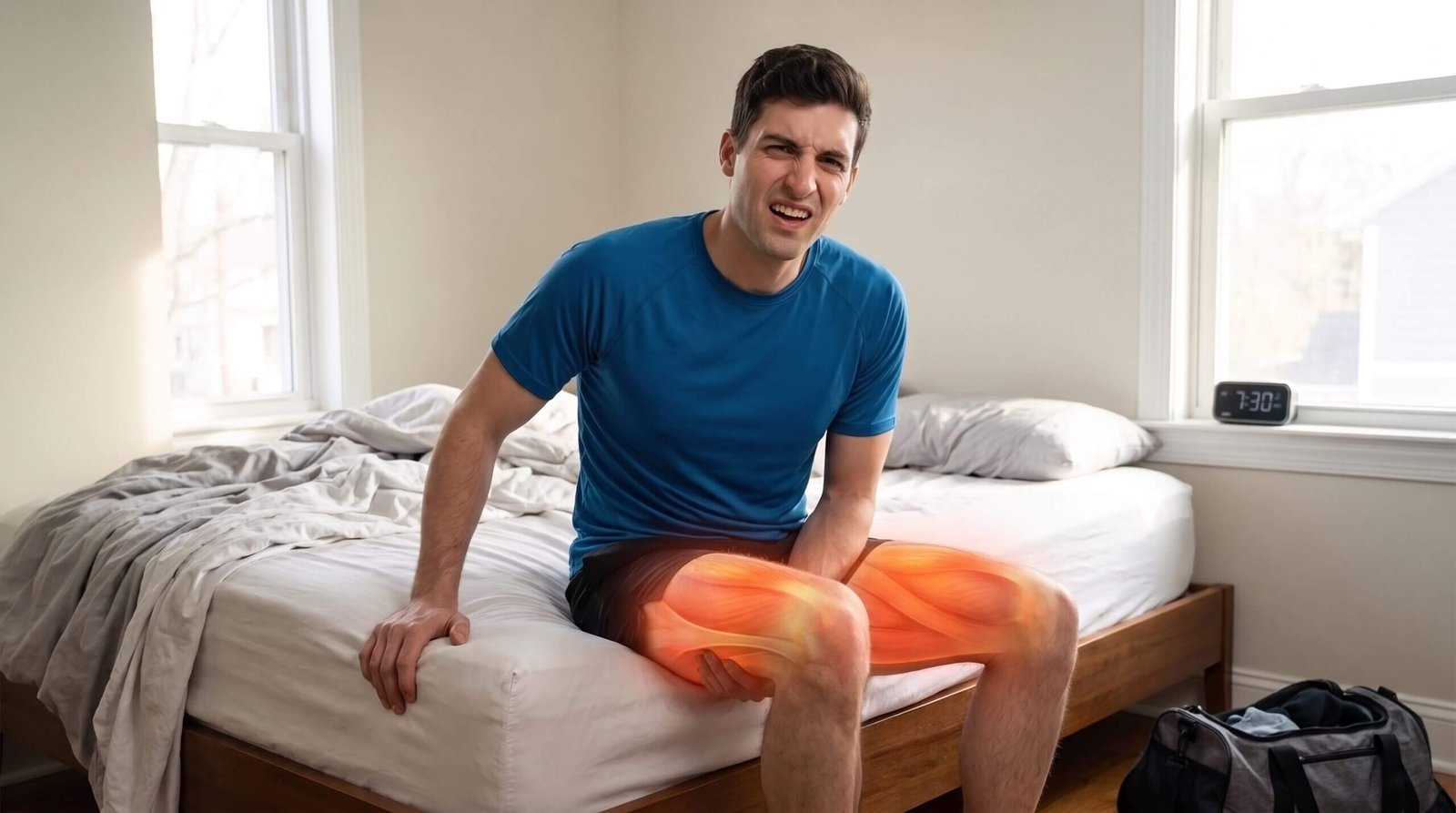
You finally get the motivation back. First day back at the gym, you go all in like you never stopped. Day two, that motivation is still there — right up until you try to get out of bed. Your legs feel like they belong to someone else. Soreness has taken over. So you skip today, tell yourself you’ll go tomorrow instead. But tomorrow comes, and somehow it feels worse, not better. Now you’re stuck wondering: should you actually push through this, or does that make things worse?
It depends. Let’s talk about what that soreness actually is.
⚠️ Disclaimer: This article is for educational and analytical purposes only. It does not constitute medical or fitness advice. Consult a qualified professional before starting any new exercise programme or if you experience persistent pain.
What Soreness Actually Is (DOMS Explained)
That ache that shows up a day or two after a hard session has a name: delayed onset muscle soreness (DOMS). It happens most after movements where your muscle is under tension while it’s lengthening — think the slow lowering part of a bicep curl, where the muscle is stretching and working at the same time. That kind of movement creates tiny amounts of damage inside the muscle fibres, throws off the normal chemical balance inside the cell, and triggers inflammation. That combination is what you actually feel as soreness and stiffness [1] [8].
Here’s the good part though: your body doesn’t forget this. The first time you do a new movement, or go back to one after a long break, that soreness hits hardest. But do that same movement again a week or two later, and it’ll usually hurt a lot less — even at the same weight, same reps. Your muscle actually adapts to that specific movement and becomes more resistant to damage from it [2]. So that brutal soreness after your first session back isn’t your new normal — it’s a one‑time tax, and it gets much easier from here.
Does No Soreness Mean You’re Not Working Hard Enough?
Not really. Once your body adapts to a movement — which usually happens within your first few sessions of doing it — that same workout stops causing much soreness at all, even if you’re still lifting the same weight or doing the same reps. That’s not you plateauing. That’s your muscle getting genuinely more resilient to that specific movement.
And if your goal is building more muscle, chasing soreness isn’t the way to do it either. What actually drives growth is progressive overload — gradually adding weight, reps, or difficulty over time — not how sore you feel afterward [6]. You can build real muscle while barely feeling sore at all, and you can be brutally sore from a workout that barely challenges you in any way that matters.
📊 Track your progress: Use our BMI Calculator to monitor body composition changes, or the Calorie Deficit Calculator to see how your training and nutrition work together.
When You Should NOT Train
There are two situations where you genuinely should stop.
First, if what you’re feeling isn’t muscle soreness at all — it’s joint pain. Muscle soreness lives in the muscle itself: press on it or contract it and it’s uncomfortable, but the feeling stays in the muscle. Joint pain sits deeper, right at the joint, and even small, gentle movements around that joint can trigger sharp, focused pain. If that’s what you’re feeling, that’s not DOMS, and it’s worth getting a professional to look at it before you load that area again.
Second, if the soreness is so bad it’s wrecking your form. Once you start compensating, shifting weight around, or letting your technique fall apart just to get through a rep, your risk of actually hurting yourself goes up. That’s your body telling you to back off, not push through.
Training While Sore: What the Research Says
Most people avoid training while sore because they believe it’ll make the soreness worse, and that it’ll hurt their gains. Neither one holds up well under research.
Light to moderate movement — easy cardio, gentle reps — doesn’t make soreness worse, and in some cases actually helps manage it and supports your recovery just as well as, or slightly better than, doing nothing at all [4] [5] [7]. And soreness itself isn’t actually a measure of how good your workout was, or how much muscle you’re building [6].
What You Should Actually Do
Keep the intensity down on whatever’s sore — lighter loads, fewer sets — or work something else entirely and let that area keep healing while you stay in motion. Remember what’s actually happening in there: torn muscle fibres, a chemical imbalance, inflammation [3] [9]. Light movement — walking, easy mobility, gentle reps — gets blood flowing through that area, and that blood flow is part of what helps it repair.
If the soreness is mild to moderate, your joints feel fine, and you can still control your movement properly, training is often the better move. Don’t let soreness become your convenient excuse. A few sore days off is how a week off happens, and a week off is how you quietly never go back.
The Bottom Line
Soreness doesn’t mean you’re building muscle. Lack of soreness doesn’t mean you’re not. Train consistently, progress gradually, and use light movement on sore days rather than skipping entirely. Train smarter, not harder.
📺 This article was adapted from a PeakPhysic video. Subscribe to PeakPhysic for more science‑backed fitness insights.
📚 Sources
- Peake JM et al. Muscle damage and inflammation during recovery from exercise. J Appl Physiol (2017).
- Proske U, Allen TJ. Eccentric muscle contractions: risks and benefits (2019).
- Pathophysiology of exercise‑induced muscle damage and its effects on performance (2020).
- Effect of active recovery protocols on the management of DOMS. Strength Cond J.
- Effect of aerobic recovery intensity on delayed‑onset muscle soreness and strength. J Strength Cond Res.
- Is postexercise muscle soreness a valid indicator of workout quality? Strength Cond J.
- Wei M et al. The impact of various post‑exercise interventions on delayed‑onset muscle soreness. Front Physiol.
- Physiopedia. Delayed Onset Muscle Soreness. Physiopedia
- Lumen Learning. Exercise‑Induced Muscle Damage. Lumen Learning
Related tools: BMI Calculator | Calorie Deficit Calculator | More articles: Analytical Living
Author: Dr. Shirley Cheung. This content is for informational purposes only and does not constitute professional fitness or medical advice.
Health & Fitness Disclaimer: The information presented in this article is data-driven and intended for educational purposes only. It is not a substitute for professional medical advice, diagnosis, or treatment. Always consult with a qualified physician or healthcare provider before beginning any new exercise regimen, diet, or lifestyle shift.