
Planks – I Don’t Feel My Abs
You’ve been doing planks, but you’re not really feeling your abs. You’re holding the position, watching the clock, and wondering: is this actually doing anything? How should a plank feel, and where should you feel it for the effort to be worthwhile?
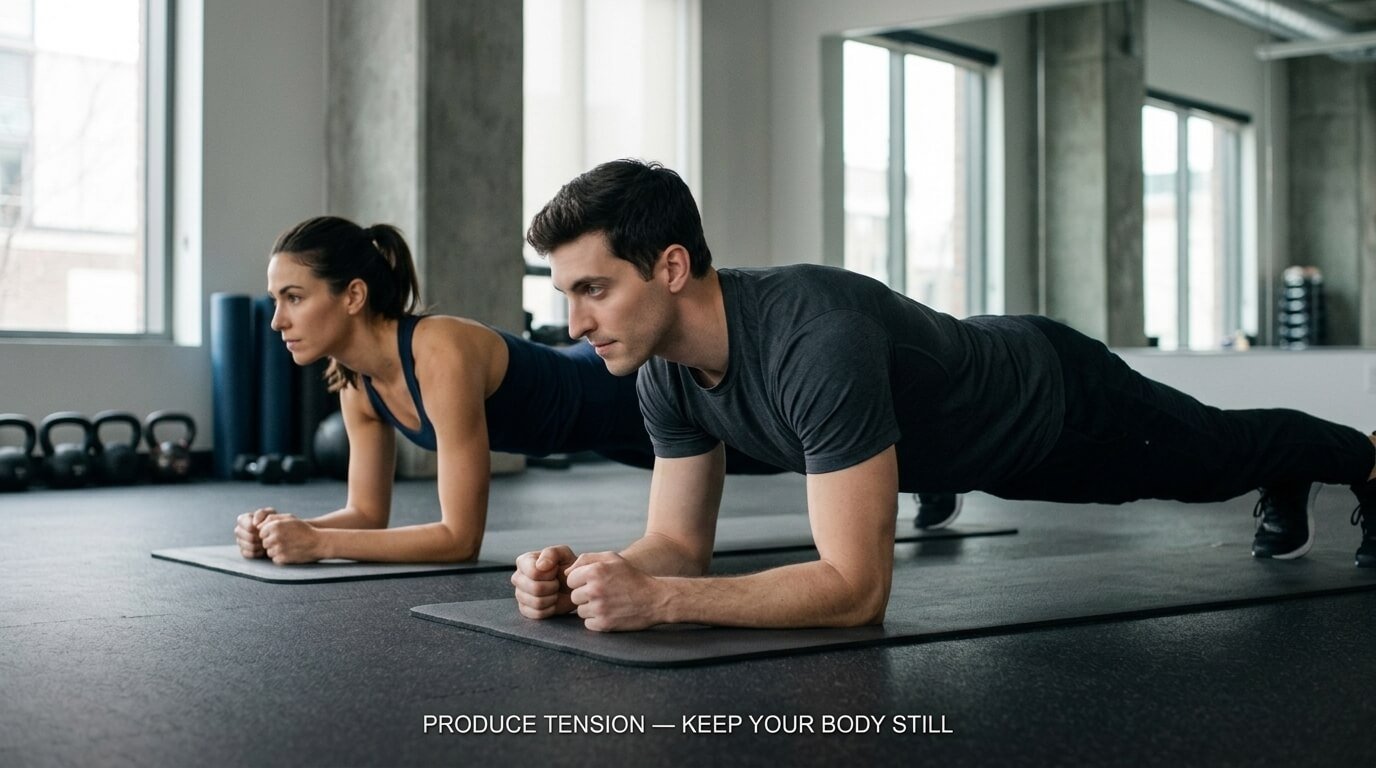
Let’s start with what your abs are actually doing. Your rectus abdominis — the muscle down the middle of your stomach — and your obliques help stop your trunk from sagging and your lower back from arching. Unlike crunches, where you repeatedly curl your trunk, a plank challenges your abdominal muscles to produce tension while keeping your body still. So don’t expect it to feel exactly like a crunch.
⚠️ Disclaimer: This article is for educational and analytical purposes only. It does not constitute medical or fitness advice. Consult a qualified professional before starting any new exercise programme.
Let’s Check Your Position
- Place your elbows directly under your shoulders, with your forearms on the floor.
- Extend your legs behind you, with your feet roughly hip-width apart.
- Your body should form a relatively straight line from your head to your heels.
- Pay attention to your rib cage and pelvis. Don’t let your stomach drop toward the floor, and don’t push your hips so high that you turn the plank into a different position.
- Gently tighten your abdomen, keep your body aligned, and breathe normally while you hold.
Watch the video above to see the movement in action.
What Should You Feel?
You may notice a steady tension or fatigue across the front and sides of your abdomen. You may also feel your shoulders and thighs working, because they help maintain the position. But you don’t need a strong burning sensation in your abs for the plank to be effective.
Here’s one reason people struggle to feel their abs: they’re expecting the same contracting sensation they get during crunches. But in a plank, your abdominal muscles are working largely without changing length very much. They’re producing tension to resist movement, rather than repeatedly shortening to curl your trunk.
If You Feel Very Little Effort
If you feel very little effort anywhere, the position may simply be too easy for your current strength. But if your lower back starts to sag, your hips drop, or you can no longer maintain your position, holding on for another thirty seconds isn’t necessarily doing you any favours. Instead, end the set when you can no longer maintain good form.
If a standard plank is too challenging, start with your hands or forearms supported on a sturdy elevated surface, making the body angle easier to control. As you get stronger, progress toward the floor. If the standard plank becomes too easy, you can increase the challenge with a more demanding variation rather than chasing longer and longer holds.
📊 Track your progress: Use our Strength Standards to benchmark your core and overall strength, or the Waist-to-Hip Ratio to monitor body composition changes.
The Purpose of a Plank
And remember, the aim isn’t to win a competition against the clock. A two-minute plank with poor alignment isn’t automatically better than a shorter hold performed with control. So what’s the real purpose of a plank? It trains your ability to maintain a controlled trunk position under fatigue. That matters whenever your body needs to stay stable while your arms and legs are producing force.
The Bottom Line
You don’t need to feel your abs burning to know they’re working. Pay attention to your position, the tension you can maintain, and whether the exercise is challenging enough for you. Train smarter, not harder.
📺 This article was adapted from a PeakPhysic video. Subscribe to PeakPhysic for more science‑backed fitness insights.
Related tools: Strength Standards | Waist-to-Hip Ratio | BMI Calculator | More articles: Analytical Living
Author: Dr. Shirley Cheung. This content is for informational purposes only and does not constitute professional fitness or medical advice.