
Glute Bridges – I Don’t Feel My Glutes
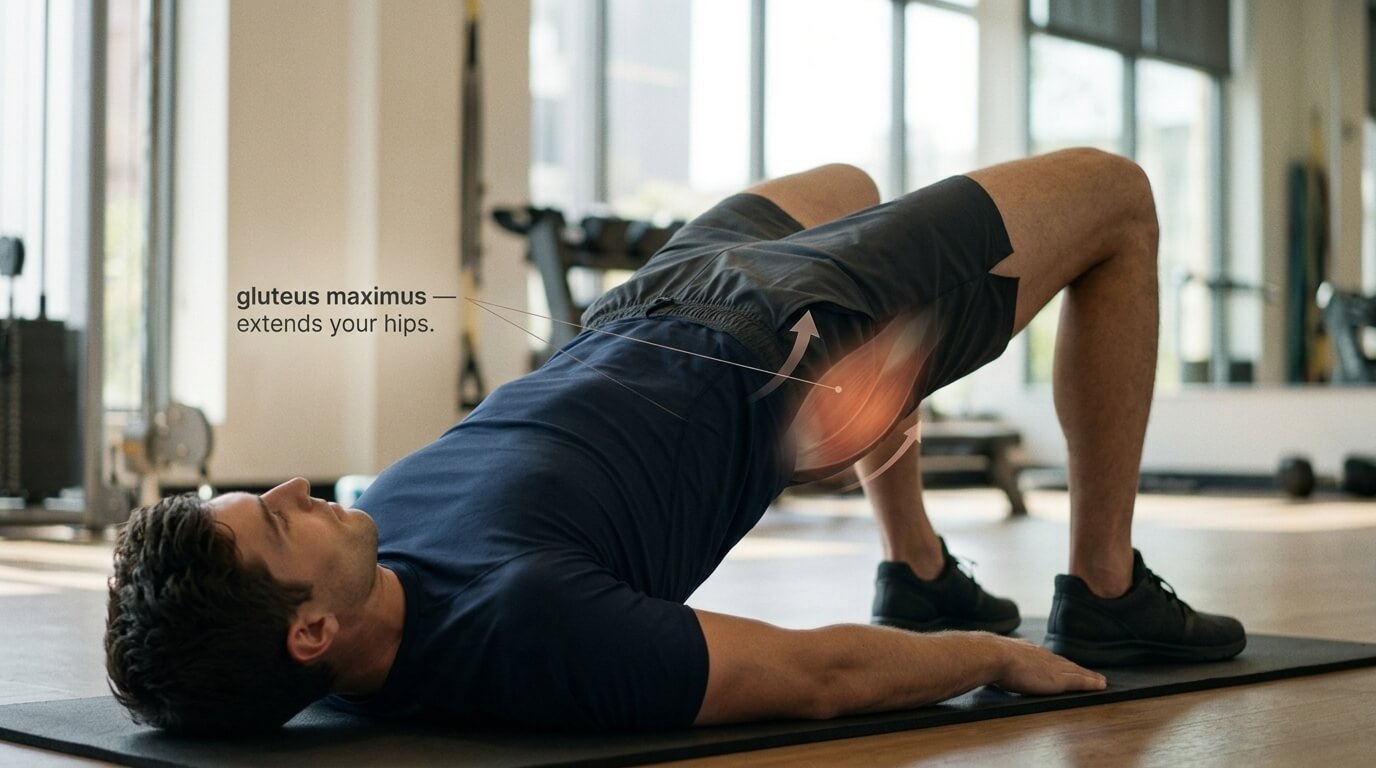
You’ve been doing glute bridges, but you’re feeling your hamstrings more than your glutes. Or maybe you’re just moving your hips up and down and wondering: where’s the effect? Glutes? Really? How should a glute bridge feel, and where should you feel it for the effort to be worthwhile?
Let’s start with the main muscle you’re trying to work: your gluteus maximus, the large muscle in your buttocks. Its job includes extending your hips, which is exactly what you’re doing when you lift your hips off the floor. Your hamstrings help with hip extension too, so it’s normal to feel them working. But if they keep cramping or dominating the sensation, let’s check your technique.
⚠️ Disclaimer: This article is for educational and analytical purposes only. It does not constitute medical or fitness advice. Consult a qualified professional before starting any new exercise programme.
How to Set Up
- Lie on your back with your knees bent and your feet flat on the floor, roughly hip-width apart.
- Start with your pelvis in a comfortable position, and gently tuck it so you’re not relying on arching your lower back to lift your hips.
- Push through your feet and raise your hips.
- Think about lifting through your hips rather than throwing your back upward.
- Stop when your shoulders, hips, and knees form a roughly straight line.
- Hold briefly, then lower yourself under control.
Watch the video above to see the movement in action.
You don’t need to lift as high as possible. If you keep pushing your hips upward by arching your lower back, you’re adding movement that isn’t coming from your hips.
Where Should You Feel the Effort?
You may feel your buttocks contracting as you lift, with some effort in the back of your thighs. The sensation varies from person to person, and you don’t need an intense burn to prove your glutes are working.
What If Your Hamstrings Keep Cramping?
One adjustment worth trying is bringing your feet a little closer to your buttocks, which bends your knees more. This can reduce the hamstrings’ contribution in some bridge variations, allowing your glutes to contribute more prominently. It doesn’t guarantee you’ll feel your glutes immediately, but it gives you a different position to work with.
Also, check how you’re lifting. Keep your ribs controlled, avoid arching your back to gain extra height, and make the movement smooth rather than bouncing up and down.
📊 Track your progress: Use our Strength Standards to benchmark your lower-body strength, or the 1‑Rep Max Calculator to estimate your hip extension strength.
How to Progress
Once bodyweight glute bridges become easy, you can make them more challenging:
- Add a weight across your hips.
- Slow down the lowering phase — make the descent take 3–4 seconds.
- Progress to a single-leg bridge — one foot on the floor, the other leg extended or lifted.
Each increases the challenge in a different way, so choose a variation you can control rather than one that simply looks harder.
The Bottom Line
And here’s the important part: a glute bridge isn’t about how high you can lift your hips or how hard you can squeeze your buttocks. It’s about producing controlled hip extension, with your glutes contributing to the work.
That hip-extension capacity matters in movements such as standing up, climbing stairs, and other activities where your hips help move your body. So the next time you do glute bridges, pay attention to your setup, control your pelvis, and look at how you’re moving — not just what you feel.
Your hamstrings don’t have to be completely silent, and your glutes don’t have to burn for the exercise to count. Train smarter, not harder.
📺 This article was adapted from a PeakPhysic video. Subscribe to PeakPhysic for more science‑backed fitness insights.
Related tools: Strength Standards | 1‑Rep Max Calculator | BMI Calculator | More articles: Analytical Living
Author: Dr. Shirley Cheung. This content is for informational purposes only and does not constitute professional fitness or medical advice.